HRC price volatility is the movement in hot rolled coil selling prices that compresses or expands a mill's margin without any change in its own operations.
When selling prices fall, the only margin still under the plant's control is the margin created between charging the furnace and dispatching the coil.
This article is written to identify where margin actually leaks between furnace and caster, and which process levers are available.
The Challenge - You Cannot Control The Price, Only the Process
Hot rolled coil price is set by markets, a mill does not influence - raw material costs, regional demand, import competition, currency movement.
A commercial team can hedge, contract forward or shift product mix. None of that changes what happens inside the melt shop.
What the melt shop controls is conversion: how much saleable product emerges from a given input, at what quality, in what time. During a soft market, that conversion efficiency is the difference between a heat that contributes and a heat that does not.
The temptation during a price squeeze is to cut consumable spending. This is usually the wrong lever, because consumables are a small share of conversion cost while having a disproportionate influence on yield and delay.
How Does HRC Price Volatility Reach The Furnace Floor?
It arrives as pressure on three specific losses. All three are measurable, and all three are influenced by process discipline.
Yield loss and rework
Yield loss is metal that entered the process but does not leave as saleable product. Some is unavoidable. Some comes from downgraded material, from crops, and from product that must be reprocessed.
Rework is worse than yield loss, because reworked material has already consumed energy, time and refractory life. In a strong market rework is absorbed. Under HRC price volatility margin pressure, it is what turns a profitable heat into a loss.
Downgrades from quality misses
A heat that misses grade specification does not become scrap; it usually becomes a lower-value product. The tonnage still ships, but at a reduced price, and the difference falls straight to margin.
Grade misses originate in the refining window - chemistry that was not homogenised, inclusions that were not floated out, dissolved gas that was not removed. These are ladle metallurgy outcomes.
Delays at tapping and refining
A furnace that cannot tap on schedule delays everything behind it. A tap hole that resists opening, a lance that fails mid-operation, a stirring plug that blocks - each adds minutes, and minutes compound across a shift.
Delay costs are rarely allocated to the consumable that caused them. That is why the connection between consumable quality and steelmaking cost per heat is often invisible in plant accounting.
Process Levers that Protect Margin
|
Margin leak |
Process lever |
Consumable involved |
|
Grade misses from uneven chemistry |
Consistent injection practice during refining |
Daiwa CA Lance - carbon, lime and oxygen injection |
|
Inclusions and dissolved gas in the ladle |
Reliable stirring through the treatment window |
Daiwa Argon Stirring Lance - top-lance argon injection |
|
Delay at tap |
Predictable tap hole opening |
Daiwa SC Lance - self-consuming oxygen lance, up to 3,000 °C |
|
Unplanned stoppage mid-operation |
Consumable consistency and inspection on receipt |
All three, under ISO 9001 quality management |
Consistent injection practice
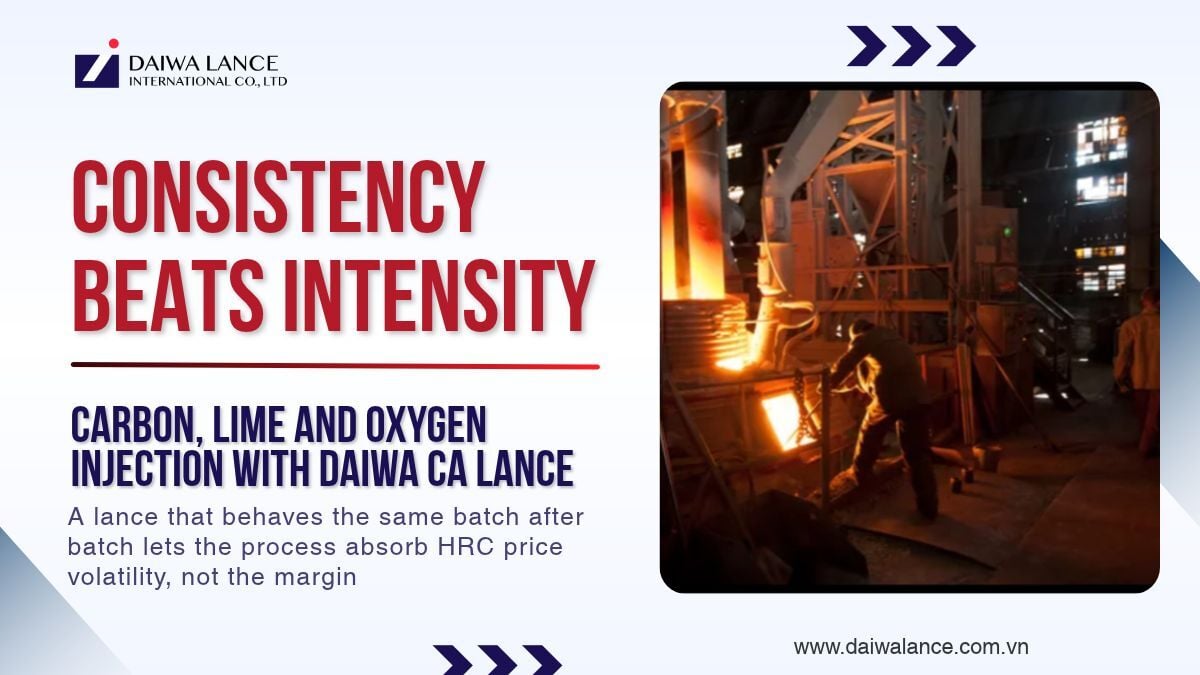
Carbon and lime injection is how an operator moves a heat onto grade. Consistency matters more than intensity.
A lance that delivers predictably allows an operator to build a repeatable practice. One that behaves differently from batch to batch forces constant compensation.
Daiwa CA Lance is a calorized lance pipe with a mild steel core protected by an aluminum–iron alloy layer and a refractory ceramic coating on both the inner and outer surfaces. This dual-layer protection improves resistance to heat and oxidation, helping reduce pipe consumption during oxygen blowing and carbon or lime injection.
Reliable ladle stirring
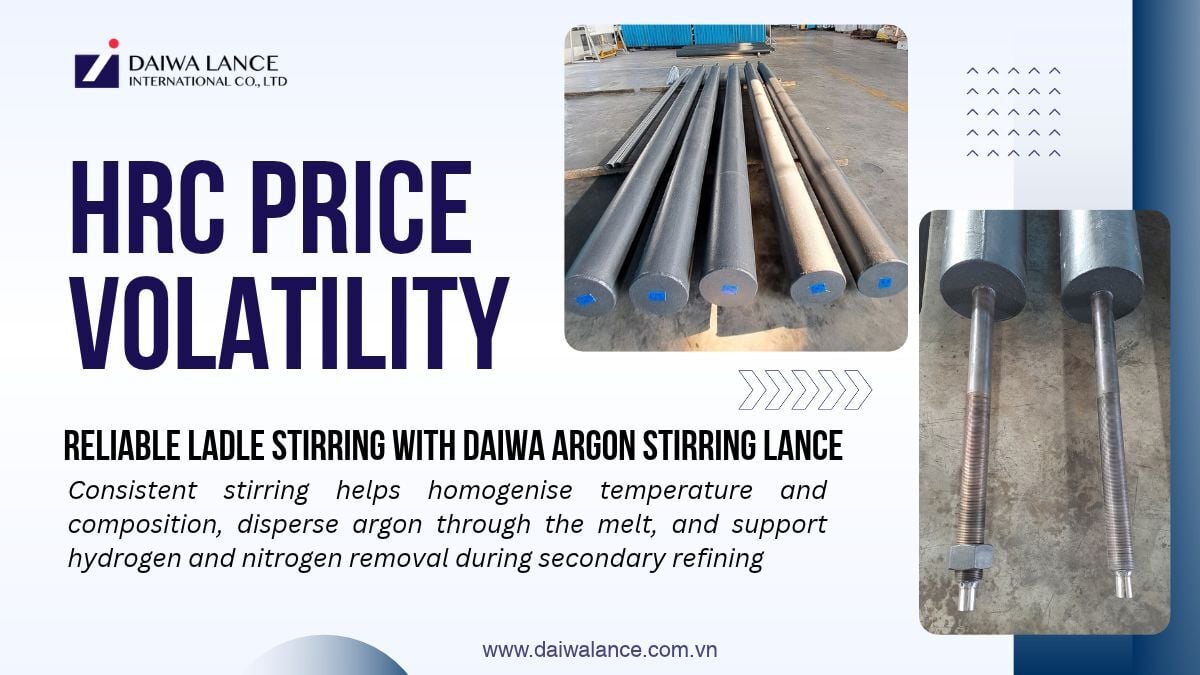
Stirring homogenises temperature and composition, disperses argon bubbles through the melt, and assists removal of dissolved hydrogen and nitrogen.
When stirring capability is lost mid-treatment, the options are to accept a compromised heat or to hold the ladle - both of which cost margin.
The Daiwa Argon Stirring Lance is submerged into the ladle from the top, which is why emergency stirring and mixing in secondary refining is among its listed applications.
Predictable consumable performance
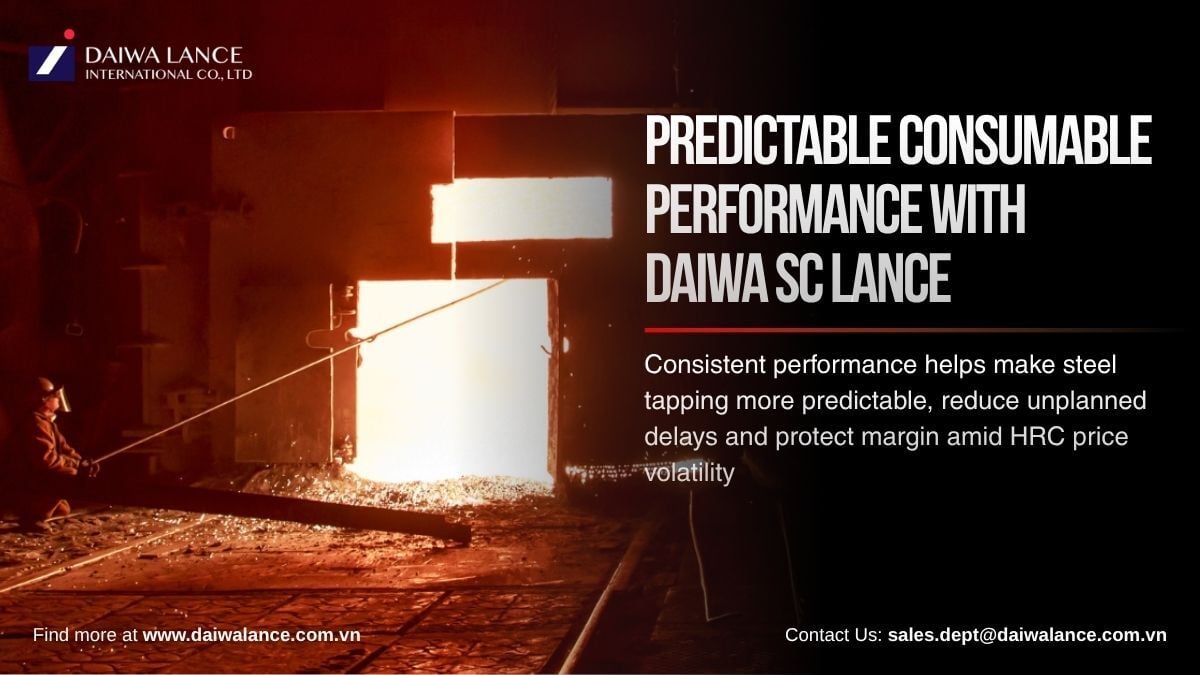
Predictability is itself a margin lever. A consumable that performs consistently allows a plant to plan; one that does not forces buffers, contingency and unplanned intervention.
This is why weld integrity, surface cleanliness and uniform wall thickness belong in the purchase specification, rather than in the receiving inspection alone.
Building The Internal Business Case for Consumable Quality
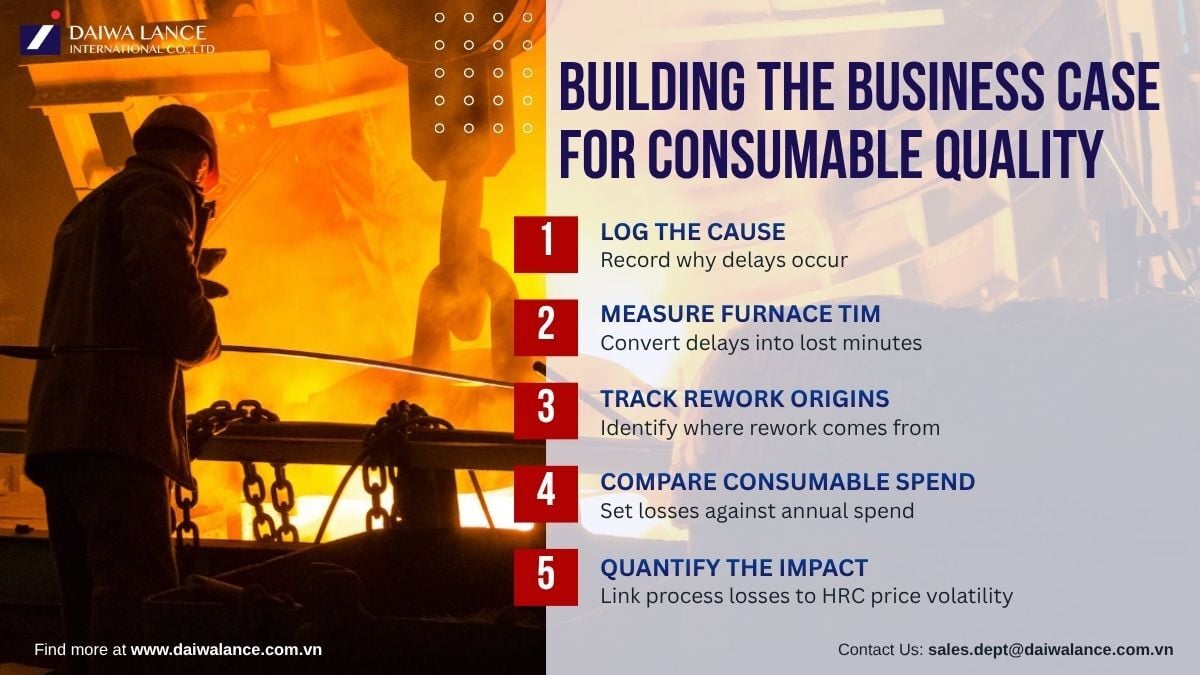
Consumable quality is difficult to defend in a cost review, because its benefit appears in other departments' numbers. A workable approach:
- Log the cause, not just the event. When a tap is delayed, record why. Without this, the connection between consumable and delay is never established.
- Convert delay to furnace time. Express incidents in minutes of furnace availability rather than in incident counts.
- Track rework by origin. Separate rework caused by refining outcomes from rework caused by downstream processing.
- Compare against consumable spend. Set the recorded losses beside the annual consumable budget for the relevant duty.
- Present the comparison, not a claim. Let the plant's own figures make the argument. Steel mill margin management decisions made on borrowed benchmarks rarely survive scrutiny.
Common Mistakes to Avoid
- Cutting consumable specification during a price squeeze without measuring the yield and delay consequences.
- Recording delays as events without recording their cause.
- Allocating delay cost to the furnace rather than to the item that caused it.
- Assuming a lower unit price produces a lower cost per heat.
- Treating stirring as optional when the treatment window is tight.
- Using benchmark savings figures from other plants instead of the plant's own data.
Manufacturing Standards Behind The Quality
Daiwa lance products are manufactured in Tan Thuan Export Processing Zone, District 7, Ho Chi Minh City, Vietnam, using Japanese steel-tube manufacturing technology and engineering discipline, backed by JIS.
Raw material is quality carbon steel. Quality management follows ISO 9001 and environmental management follows ISO 14001.
Exports reach more than 52 countries with full export documentation. For mills managing margin under import-dependent supply, documentation completeness contributes directly to schedule reliability.
Conclusion
HRC price volatility will continue, and no melt shop controls it.
What a melt shop does control is how much saleable product it produces per heat, at what grade, and how reliably it holds schedule. Those three variables are shaped in the refining window and at the tap - and the consumables used there are a small share of cost with a large share of influence.
Measure the losses before cutting the spend. If you are looking for lancing, injection and stirring solutions matched to your steelmaking conditions, Daiwa Lance can advise on selecting the right product - Daiwa SC Lance, Daiwa CA Lance or Daiwa Argon Stirring Lance - for your operating requirements.
FAQs
Why is cutting consumable spend usually the wrong response to a price squeeze?
Because consumables are a small share of conversion cost, but influence yield, grade compliance and schedule reliability disproportionately. A reduction in consumable specification that produces one additional grade miss or one extended tap delay per week can cost more than the saving. The decision should follow measurement of losses, not precede it.
Where does margin actually leak between furnace and caster?
In three places: yield loss and rework, downgrades caused by grade misses, and delays at tapping and refining. Grade misses originate in the refining window, where chemistry homogenisation, inclusion removal and dissolved gas removal take place. Delays originate at operations such as tap hole opening, where consumable reliability is directly involved.
How does ladle stirring affect product grade?
Argon stirring homogenises temperature and composition through the ladle, disperses bubbles through the molten steel, and assists removal of dissolved hydrogen and nitrogen. When stirring is interrupted mid-treatment, the plant must either accept a compromised heat or hold the ladle - both of which affect margin.
What temperature does a Daiwa SC Lance reach at the tap hole?
A Daiwa SC Lance generates temperatures up to 3,000 °C at the working tip. It is self-consuming, burning itself using oxygen only, with no external fuel gas supplied during operation. That temperature is what allows it to burn through hardened tap hole filler and solidified metal so a tap can proceed on schedule.
How should a plant build the case for consumable quality internally?
Using its own data. Log the cause of every delay, express incidents in minutes of furnace availability, separate rework by origin, and compare the total against the consumable budget for that duty. A case built on the plant's own recorded losses survives review; one built on external benchmark percentages generally does not.
Related Blogs & Pages
- Website: https://www.daiwalance.com.vn/
- Catalogue page: https://www.daiwalance.com.vn/catalogue
- Contact page: https://www.daiwalance.com.vn/contact
- Daiwa CA Lance product page: https://www.daiwalance.com.vn/products/daiwa-ca-lance
- Daiwa SC Lance product page: https://www.daiwalance.com.vn/products/daiwa-sc-lance
- Alumina Protection: The Science Behind Daiwa CA Lance’s 3~10x Longer Service Life: https://www.daiwalance.com.vn/blog/alumina-protection-the-science-behind-daiwa-ca-lance-3-10x-longer-service-life
- 4 Benefits You Could Expect in Daiwa SC Lance: https://www.daiwalance.com.vn/blog/4-benefits-you-could-expect-in-daiwa-sc-lance
- Why is The Argon Stirring Lance Used As An Emergency Lance in Steelmaking?: https://www.daiwalance.com.vn/blog/why-is-the-argon-stirring-lance-used-as-an-emergency-lance-in-steelmaking
- Improving Steel Quality Through Daiwa Argon Stirring Lance: https://www.daiwalance.com.vn/blog/improving-steel-quality-through-daiwa-argon-stirring-lance
- Desulfurization In Ladle Refining Furnace: https://www.daiwalance.com.vn/blog/desulfurization-in-ladle-refining-furnace
About Daiwa Lance
Established since 1997, Daiwa Lance has positioned ourselves as a pioneer in thermic cutting and oxygen lancing technology. Based in Ho Chi Minh City, Vietnam, we have been providing quality customer service and products with advanced Japanese technology.
We maintain the highest quality standards with ISO 9001:2015, ISO 14001:2015, and JIS G standards certifications. We have also expanded our reach globally, exporting to over 55 countries worldwide.
Visit us through our contact channels today: Email, WhatsApp, Contact Us form, or connect with us on Youtube, LinkedIn and Facebook.