A steel consumable inventory strategy is the set of rules a plant uses to decide how much consumable stock to hold, how often to order, and how to specify items so that freight movements do not disrupt production.
It matters because when container rates swing, the delivered cost and arrival date of imported consumables move with them.
This blog covers what drives landed cost, how to size stock against heat count, and which specification choices affect shipping.
The Challenge - Freight Turns a Stable Consumable Into A Variable Cost
Lance pipes are basically a stable product. The specification does not change from quarter to quarter, consumption is predictable, and manufacture is routine.
What is not stable is what it costs to move them.
Container rates move for reasons outside a steel plant's control - corridor disruption, vessel availability, seasonal demand, port congestion. When they move sharply, two things happen at once:
- The delivered cost of an already-agreed purchase price rises.
- The transit time becomes less predictable.
Neither problem is solved by renegotiating the unit price. Both are managed through inventory policy and specification discipline.
What Drives Landed Cost on Lance Pipe?
Landed cost is the delivered cost of goods at the plant gate: product cost plus freight, insurance, duties and handling. On the freight side, two factors dominate for lance pipes.
Length, packing and volumetric considerations
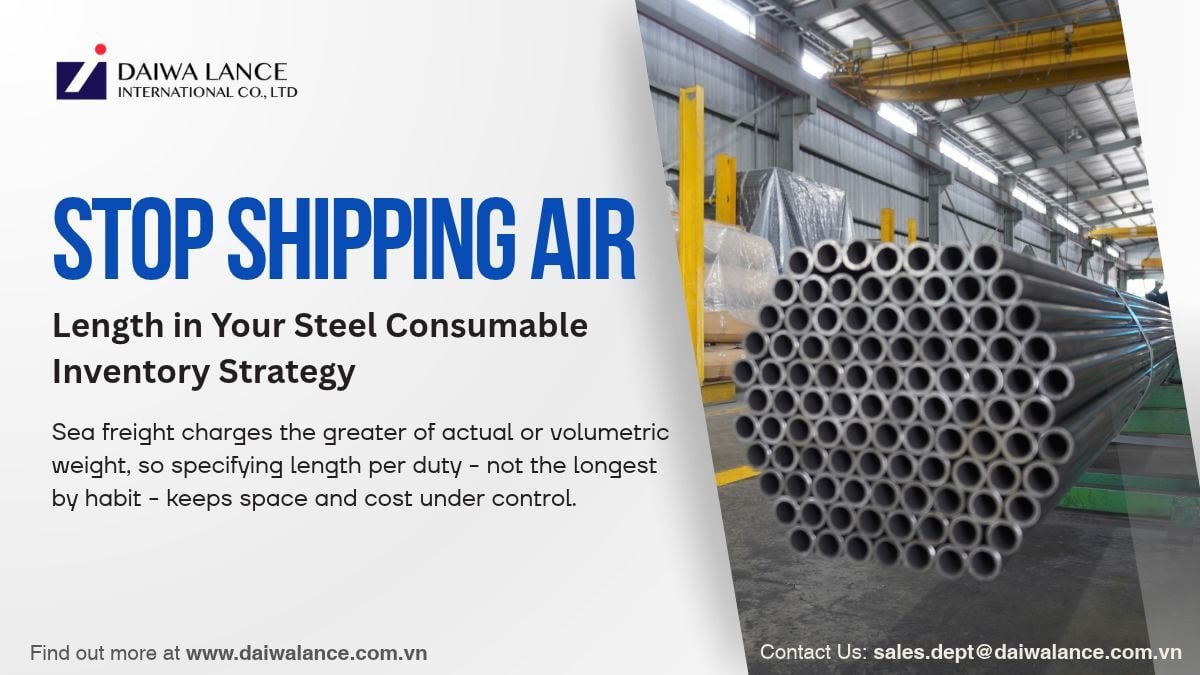
Lance pipes are long, slender and comparatively light for the space they occupy. Sea freight is frequently charged on whichever is greater - actual weight or volumetric weight. For a product of this shape, volume often governs.
That makes length a commercial variable, not only a technical one. The oxygen lance ranges give real room to work with:
| Product | Nominal size / outside diameter (OD) | Wall thickness (mm) | Length (mm) |
|---|---|---|---|
| Daiwa CA Lance | Standard size range: 1/4"–2" | Typically 2.0–4.0, depending on size | Standard lengths: 2,750 or 5,500, depending on size |
| Daiwa CC Lance | 1/4"–2"; OD 13.8–60.5 mm | 2.0–4.0 | 2,750–5,500 for sizes 1/4"–1-1/2"; 2,000–6,000 for size 2" |
| Daiwa SC Lance | 6A (1/8")–20A (3/4"); OD 10.5–27.2 mm | 1.6–2.8 | 1,000–6,000 |
| Daiwa Mini Lance (SC Lance range) | OD 6–10 mm | Customizable | Confirm with Daiwa |
| Daiwa Thermic Lance | Published test examples: 1/4" (OD 13.8 mm), 3/8" (OD 17.3 mm), 1/2" (OD 21.7 mm) | Confirm for the selected configuration | 3,000 in published cutting tests; other lengths on request |
| Daiwa Argon Stirring Lance | Steel core pipe OD 48.6–60.5 mm | Core pipe: 3.6–14.2 | Core pipe: 4,000–6,000; total assembly: 5,500–7,550 |
| Daiwa Aluminum Lance | Confirm with Daiwa | Confirm with Daiwa | Confirm with Daiwa |
Other sizes can be produced on request.
Order frequency versus holding cost
- Frequent small orders keep working capital low, but expose the plant to every freight movement.
- Infrequent large orders smooth freight exposure, but tie up capital and warehouse space and increase the quantity at risk if a specification changes.
There is no universally correct answer. There is a correct answer for a given plant, found by comparing the cost of holding against the cost of exposure - not by defaulting to whichever pattern the previous buyer used.
How to Build a Steel Consumable Inventory Strategy?
Forecasting consumption from heat count
Consumable demand does not track annual tonnage. It tracks operations.
Tap hole opening happens once per tap. Injection work happens once per refining cycle. Ladle stirring happens once per treated heat. Each of these is counted in heats, not tonnes.
A plant that increases heat count while holding tonnage flat - smaller heats, more of them - will consume more lance pipe on the same production figure.
Build the forecast this way:
- Count scheduled heats per week for each furnace.
- Record actual consumption per heat by duty over a representative period.
- Multiply, then add a documented allowance for abnormal events such as repeated tap hole difficulty.
- Review whenever furnace scheduling changes, not annually by calendar.
Setting safety stock and reorder points
Safety stock exists to absorb variability in demand and in supply. Under freight volatility, the supply side dominates: the question is not how much consumption might rise, but how late a consignment might arrive.
Set the reorder point against a pessimistic transit assumption rather than an average one. A consumable stocking policy calibrated to the average transit time will fall short roughly half the time - not an acceptable service level for a furnace consumable.
Specification Choices that Affect Shipping
Choosing length within the available range
Specify the length the duty requires, not the maximum available. If a tap hole operation is safely performed with a shorter lance and an appropriate connection type, a shorter lance ships more efficiently and handles more easily.
Length is a safety parameter first - the operator must maintain adequate standoff from the tap stream. This is a decision to make with the operations team, not for them.
Consolidating sizes across duties
Many plants carry more distinct sizes than their duties actually require, usually because each size was introduced to solve a specific problem and never reviewed afterwards.
Consolidating has four practical effects:
- Fewer stock lines, with higher quantity per line.
- Simpler lance pipe order planning.
- Lower chance of a stockout in one size while another sits idle.
- Easier second-source qualification, because fewer specifications need approving.
Common Mistakes to Avoid
- Forecasting consumable demand from tonnage instead of heat count.
- Standardizing on maximum length for every duty and shipping unnecessary volume.
- Setting reorder points against average transit time rather than a pessimistic case.
- Carrying more distinct sizes than the duties require.
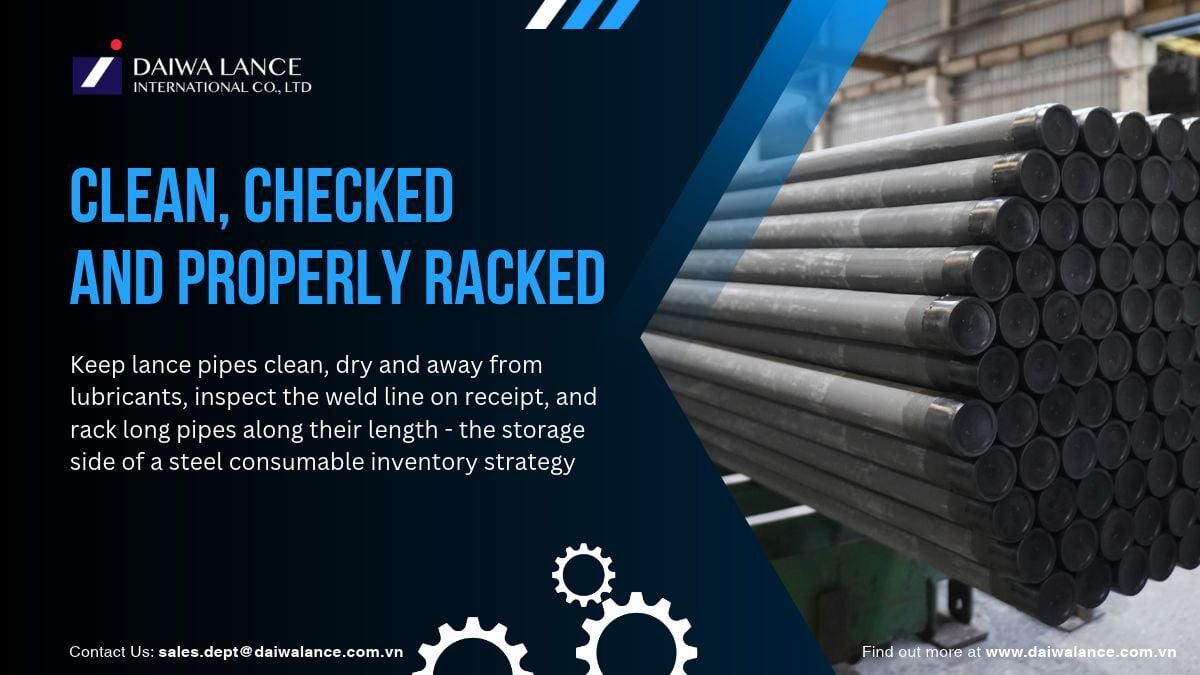
- Storing lance pipes where oil, grease or moisture can reach them.
- Inspecting incoming material only at the point of use.
- Treating a freight spike as a reason to renegotiate unit price rather than to revisit stocking policy.
Manufacturing Standards Behind the Quality
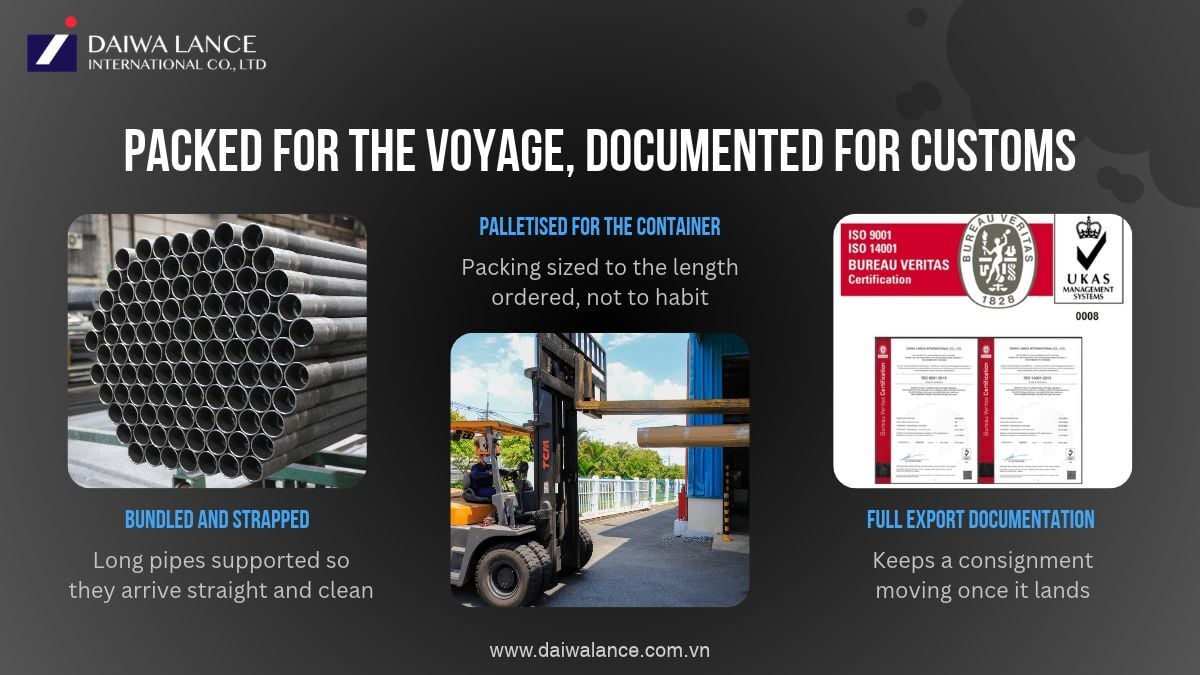
Daiwa lance products are manufactured in Tan Thuan Export Processing Zone, District 7, Ho Chi Minh City, Vietnam, using Japanese steel-tube manufacturing technology and engineering discipline, backed by JIS.
Raw material is quality carbon steel, produced under ISO 9001 quality management with ISO 14001 environmental management.
Exports reach more than 52 countries with full export documentation. For buyers managing freight volatility procurement, documentation completeness is what keeps a consignment moving once it has arrived - an often-overlooked component of effective transit time.
Conclusion
Freight volatility is not a purchasing problem to be negotiated away. It is a planning problem to be absorbed.
A steel consumable inventory strategy built on heat count, pessimistic transit assumptions, disciplined length specification and a consolidated size list will hold up through rate movements that would otherwise reach the furnace floor.
Review it when furnace scheduling changes, not when the annual budget falls due.
Freight costs will keep fluctuating, but production planning does not have to move with them. If you need lance pipes with published specifications, flexible lengths and Vietnam-based manufacturing, Daiwa Lance can advise on specifications, lengths and supply schedules matched to your actual consumption.
FAQs
Should consumable demand be forecast from tonnage or heat count?
From heat count. Tap hole opening, injection and ladle stirring each occur on a per-operation basis rather than per tonne. A plant running smaller, more frequent heats will consume more lance pipe at the same annual tonnage. Rebuild the forecast whenever furnace scheduling changes, rather than reviewing it once a year.
Does Lance length affect shipping cost?
It can. Sea freight is often charged on the greater of actual or volumetric weight, and lance pipes are long and light for the space they occupy, so volume frequently governs. Specifying the length the duty requires - within published ranges such as 1,000-6,000 mm for the Daiwa SC Lance - avoids shipping unnecessary volume.
What length ranges are available?
Daiwa CA Lance comes in standard lengths of 2.75 or 5.5 m, depending on size. CC Lance ranges from 2.75–5.5 m for sizes 1/4"–1-1/2" and 2–6 m for size 2", while SC Lance ranges from 1–6 m. Argon Stirring Lance has a total assembled length of 5.5–7.55 m. For Thermic, Mini and Aluminum Lance lengths or custom requirements, contact Daiwa to confirm availability.
How should safety stock be set under freight volatility?
Against a pessimistic transit assumption rather than an average. Under rate volatility the dominant uncertainty is arrival date, not consumption rate. A reorder point calibrated to average transit will be late roughly half the time, which is not an acceptable service level for a consumable that stops the furnace when it runs out.
Is it worth reducing the number of lance sizes held?
Often yes - but on technical grounds only. Many plants carry sizes introduced to solve a specific past problem and never reviewed since. Consolidating where duties genuinely permit it reduces stock lines, simplifies ordering and makes a second source easier to qualify. Where a duty genuinely requires a different diameter or wall thickness, keep it.
Related Blogs & Pages
- Website: https://www.daiwalance.com.vn/
- Catalogue page: https://www.daiwalance.com.vn/catalogue
- Contact page: https://www.daiwalance.com.vn/contact
- Daiwa SC Lance product page: https://www.daiwalance.com.vn/products/daiwa-sc-lance
- Daiwa CC Lance product page: https://www.daiwalance.com.vn/products/daiwa-cc-lance
- 4 Benefits You Could Expect in Daiwa SC Lance: https://www.daiwalance.com.vn/blog/4-benefits-you-could-expect-in-daiwa-sc-lance
- Daiwa SC Lance | A Self-consuming Lancing Solution For Steel Manufacturing: https://www.daiwalance.com.vn/blog/self-consuming-sc-lance-for-steel-manufacturing
- A Comprehensive Guide to Understanding CC Lance Pipe: https://www.daiwalance.com.vn/blog/a-comprehensive-guide-to-understanding-cc-lance-pipe
- More About Structure and Size of CC Lance Pipe: https://www.daiwalance.com.vn/blog/more-about-structure-and-size-of-cc-lance-pipe
- Key Applications of Ceramic Coated Lance Pipe (CC Lance): https://www.daiwalance.com.vn/blog/key-applications-of-ceramic-coated-lance-pipe-cc-lance
About Daiwa Lance
Established since 1997, Daiwa Lance has positioned ourselves as a pioneer in thermic cutting and oxygen lancing technology. Based in Ho Chi Minh City, Vietnam, we have been providing quality customer service and products with advanced Japanese technology.
We maintain the highest quality standards with ISO 9001:2015, ISO 14001:2015, and JIS G standards certifications. We have also expanded our reach globally, exporting to over 55 countries worldwide.
Visit us through our contact channels today: Email, WhatsApp, Contact Us form, or connect with us on Youtube, LinkedIn and Facebook.