Standard steel tubing fails under moisture because water and oxygen react with the exposed metal surface, and even a galvanized zinc layer gradually thins as it reacts with humid air and industrial gases. Once the protective layer is gone, rust penetrates the base steel, reduces wall thickness, and weakens the structure. Daiwa Color Pipe resolves this by sealing a galvanized steel pipe under a polyester resin coating applied to both the inner and outer surfaces, isolating the metal from moisture entirely.
This article explains the technical reasons behind moisture-induced failure in ordinary steel tube, how the coating structure of Daiwa Color Pipe addresses each failure mode, and what procurement teams should check before switching materials.
The Cost of Moisture-Induced Corrosion in Heavy Industries
Moisture-induced corrosion shortens structural service life and creates direct safety risks, which makes material selection a cost and safety decision, not just an engineering preference. Many layout plans default to carbon steel or basic galvanized tube for frames, support posts, and partitioning, but facilities dealing with high humidity, temperature swings, and chemical vapors see early structural rust.
When ordinary structural tubes are exposed to continuous dampness, moisture penetrates the base metal, leading to deep oxidation, mechanical degradation, and eventual structural breakdown. Understanding why typical steel materials fail under high humidity allows procurement teams to make data-driven material selections instead of repeating replacement cycles.
Why Standard Galvanized Steel Tubing Fails in High-Humidity Environments
Standard galvanized tube fails in humid environments because its zinc layer is sacrificial: it protects the steel by reacting first, and that reaction steadily consumes it. Water molecules and ambient oxygen form an oxidation reaction on the metal surface, and without an additional external barrier the rust cycle moves inward, reducing the tube’s effective wall thickness.
Over time, sulfur compounds, saline moisture, or industrial vapors degrade the zinc coat and form white rust (zinc corrosion products such as zinc carbonate). This chemical reaction gradually thins the coating until the core steel is exposed. In a galvanized-versus-color-pipe comparison, the key difference lies in surface porosity and chemical stability: zinc alone reacts with the environment, while a resin-sealed surface does not.
For structural projects, this surface degradation leads to a measurable drop in load capacity. As rust develops, the steel loses tensile strength and stiffness, making the tube susceptible to bending, cracking, or breaking under normal structural weight. In coastal construction, chemical warehouses, or modern agricultural facilities, this decay creates real operational hazards. Dependable moisture resistance requires isolating the metal core from atmospheric elements entirely.
How Daiwa Color Pipe Builds Its Multi-Layer Protection
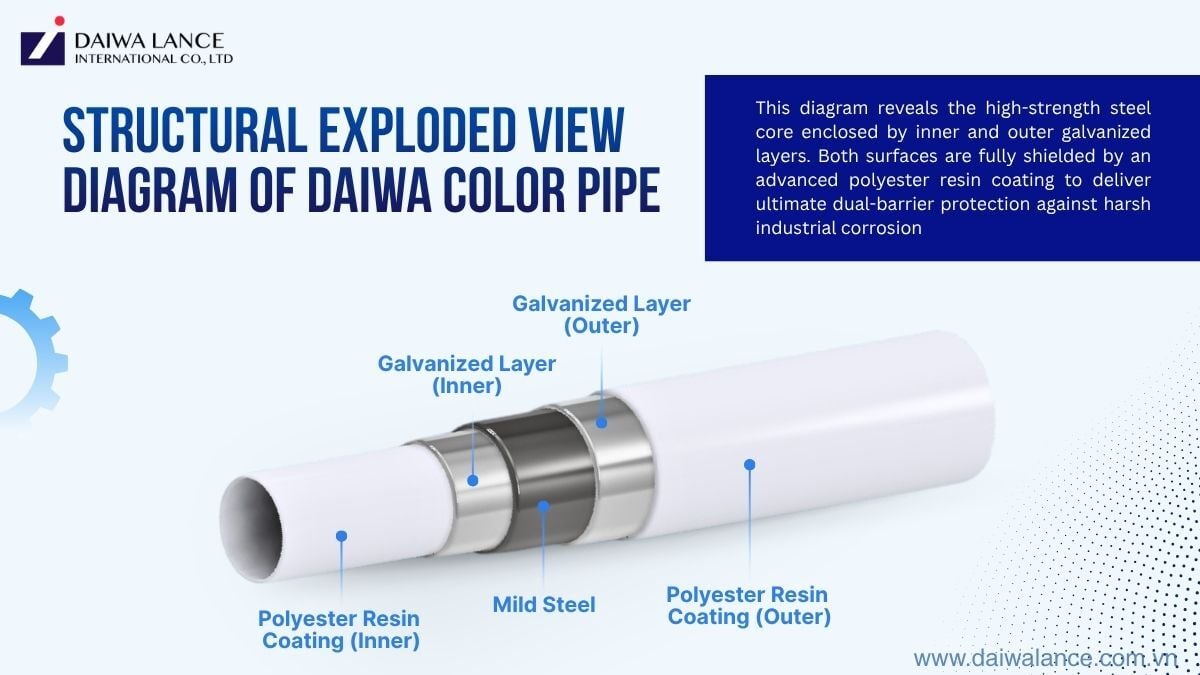
Daiwa Color Pipe uses a two-stage barrier: the core steel tube is galvanized, and a polyester resin coating is then applied over the zinc on both the internal and external surfaces. Each layer covers the weakness of the other.
The zinc layer provides the familiar sacrificial protection of galvanized steel. The polyester resin layer on top works as a non-porous shield that seals the zinc substrate away from atmospheric oxygen and moisture. This prevents the zinc from forming white rust and keeps the core steel structurally sound over long service cycles - behavior confirmed in Daiwa’s own corrosion testing, where the resin-coated surface outperformed standard galvanized pipe under humid conditions.
Because the coating is applied inside and out, the protection also covers the internal surface - important for applications such as greenhouse winding shafts and dip pipes, where moisture can reach the inside of the tube. The smooth resin topcoat additionally resists scratching during normal site handling, so minor impacts do not open a path to the metal.
Galvanized Pipe vs Daiwa Color Pipe: A Quick Comparison
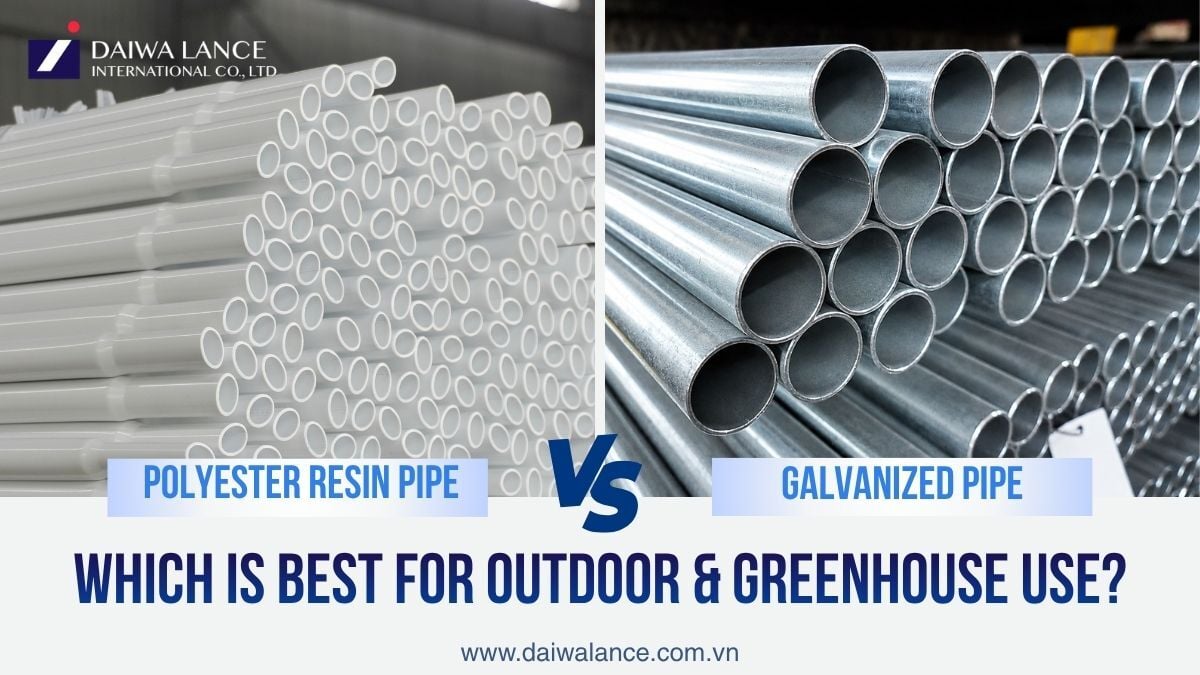
The practical difference between the two materials comes down to how long the protective surface survives in a wet environment. The comparison below summarizes the failure modes discussed above:
- Protection principle – galvanized: sacrificial zinc that is consumed over time; Daiwa Color Pipe: zinc layer sealed under a non-porous polyester resin coating inside and out.
- Behavior in humid air – galvanized: forms white rust and gradually thins; Daiwa Color Pipe: resin barrier keeps moisture and oxygen away from the zinc, confirmed in Daiwa’s corrosion testing.
- Surface handling – galvanized: scratches expose zinc directly; Daiwa Color Pipe: the resin topcoat absorbs minor site-handling abrasion.
- Maintenance profile – galvanized: periodic rust remediation and earlier replacement in wet service; Daiwa Color Pipe: longer service intervals and lower long-term replacement cost.
- Appearance – galvanized: dull gray that stains over time; Daiwa Color Pipe: clean white finish that also improves light reflection in greenhouses.
Galvanized pipe remains adequate for dry, indoor, low-exposure structures. Once continuous humidity, condensation, or coastal air enters the picture, the sealed coating structure is what determines service life.
Workforce Safety and Worksite Reliability: Production Standards
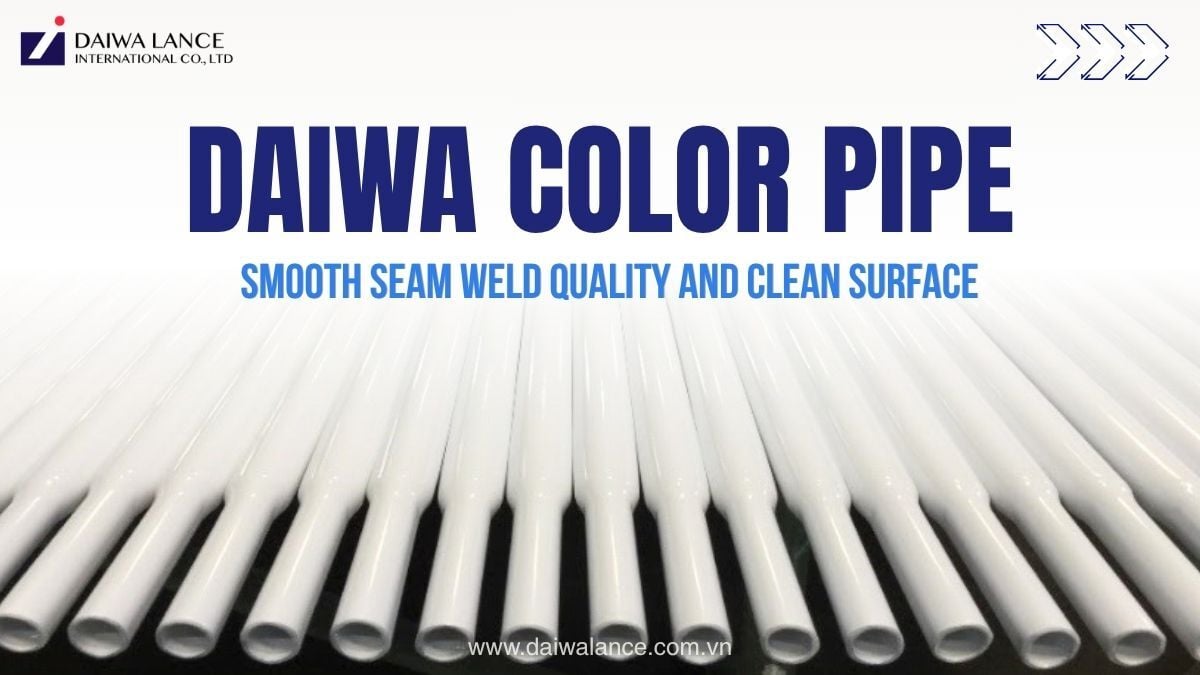
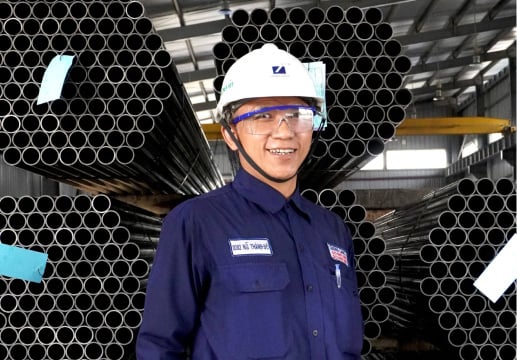
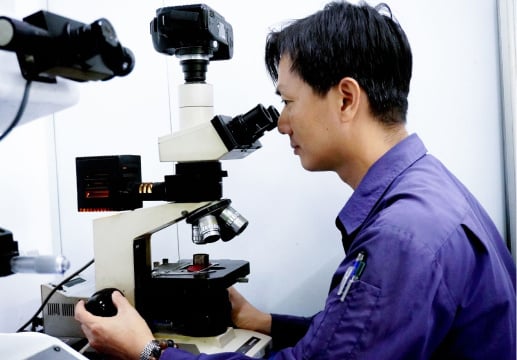
Structural tube quality is a worker-safety issue: handrails, scaffolds, and frames carry people and loads, so a hidden manufacturing defect becomes a field hazard. Daiwa Lance applies strict quality controls across the production cycle of Daiwa Color Pipe:
- Consistent seam welds – uniform seam welding, checked during production, prevents splitting under load and eliminates weak points in frames and scaffolding.
- Oil-free, residue-free surfaces – inner and outer surfaces are kept free of oils, lubricants, and hydrocarbons, which supports coating adhesion and safe handling.
- Controlled wall thickness and straightness – wall thickness is tightly managed (typically 1.2 mm to 2.0 mm depending on size) so each tube stays straight and rigid and does not bend unexpectedly under load.
- Strict quality management – production batches are inspected under an ISO 9001-certified quality management system.
- Certified quality and environmental management – ISO 9001, ISO 14001, and JIS certifications back every production run.
Standard outer diameters (approximately 19.1 mm to 50.8 mm) are maintained to tight tolerances so connectors, brackets, and automated cutting systems fit correctly. Confirm the current dimensional lineup in the official catalogue when preparing drawings.
Practical Applications: Where the Coating Makes the Difference
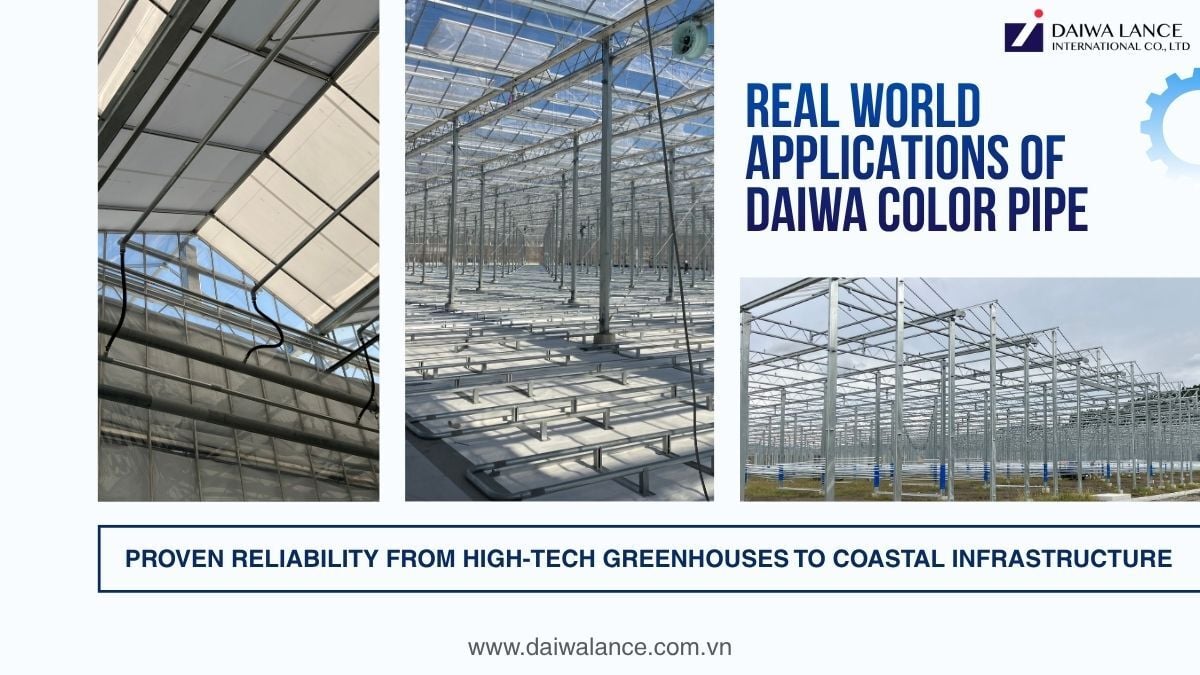
Daiwa Color Pipe is most valuable exactly where standard steel fails: humid, wet, or salt-exposed environments. Its resistance to moisture, salt-laden air, and weathering reduces inspection and replacement cycles, which is where the long-term cost advantage comes from.
In industrial plants, typical uses include safety handrails, pedestrian barriers, and equipment guards around wet-processing machinery, as well as material storage racks, overhead supports in high-dust warehouses, and structural framing in humid processing rooms.
In agriculture, greenhouses create a corrosive, humid microclimate through irrigation and fertilizers. The white resin finish improves indoor light reflection for plant growth while protecting greenhouse frames, winding shafts, and dip pipes from rust.
Outdoors, the tube withstands rain, coastal air, and water splashes, making it a dependable choice for shoreline fencing, port handrails, and other coastal infrastructure where standard zinc-coated steel degrades quickly. Actual service life depends on site conditions and maintenance, so review your exposure profile with the technical team before specifying.
B2B Procurement and Supply Chain Logistics for Bulk Sourcing
Integrating a new material grade into a corporate supply chain requires more than product approval; it also depends on reliable logistics planning, clear lead times, minimum order quantities, and stable pricing. For large-scale infrastructure projects or ongoing manufacturing operations, spot-market sourcing can create unnecessary cost fluctuations and supply uncertainty. As a result, procurement managers often reduce risk by negotiating wholesale pricing directly with the factory and planning bulk shipments in advance.
This approach helps protect operations from steel market volatility while lowering the per-meter cost compared with purchasing through regional distributors. It also gives buyers better control over delivery schedules, inventory planning, and long-term project budgeting.
Daiwa Color Pipe supports this procurement model with a production system built on internationally recognized standards. The product is manufactured under ISO 9001 and ISO 14001 certified management systems, with JIS certification covering the factory’s steel pipe production. Using Japanese-derived technology and high-quality materials from Japan, Daiwa Color Pipe is positioned for buyers who need consistent quality as well as dependable supply.
To make bulk sourcing more practical, the minimum order quantity starts at 50 pipes, allowing buyers to conduct pilot testing before committing to high-volume contracts. Free samples are also available for evaluation, helping procurement teams confirm product suitability before scaling up orders.
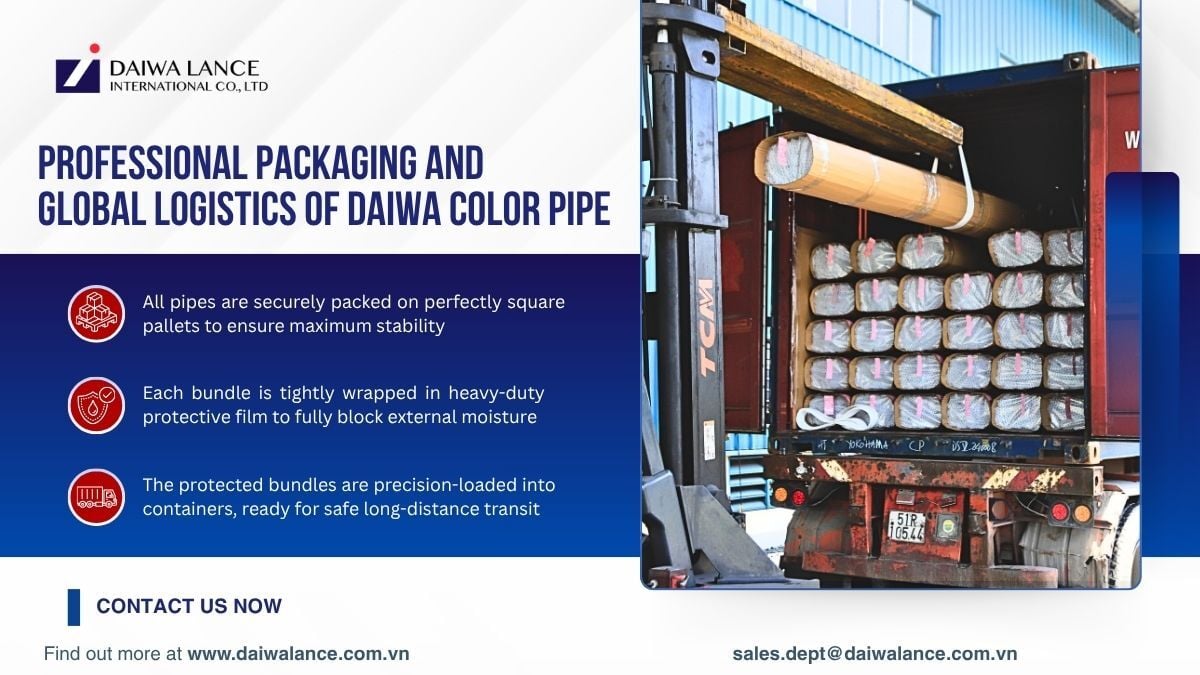
For international buyers, Daiwa Lance exports to more than 52 countries and supports shipments with essential export documentation, including certificates of origin, fumigation certificates, and packing records. This helps reduce customs-related complications and keeps cross-border deliveries moving more smoothly. To align procurement with project timelines, buyers should request a confirmed lead time during the quotation stage, ensuring that deliveries can be synchronized with construction schedules or planned plant maintenance windows.
FAQ – Technical and Sourcing Questions About Daiwa Color Pipe
Why does standard zinc galvanization fail to prevent long-term moisture penetration?
Because zinc protection is sacrificial and gradually consumes itself. Reactions with moisture, oxygen, and industrial gases create white rust that thins the zinc layer until water reaches the steel base. Daiwa Color Pipe adds a polyester resin coating over the zinc, creating a non-porous seal that stops water from reaching the metal in the first place.
How does the polyester resin coating stop atmospheric oxidation?
The resin layer forms a continuous, non-porous film over the galvanized surface, so oxygen and water vapor cannot contact the zinc or the steel beneath it. Whether the tube is used as a dip pipe in a greenhouse or exposed to coastal air outdoors, the coating blocks the chemical reactions that drive rust.
What are the main dimensional options of Daiwa Color Pipe?
Typical outer diameters cover the common structural range of approximately 19.1 mm to 50.8 mm, with wall thicknesses of roughly 1.2 mm to 2.0 mm depending on size. Confirm the current lineup in the official catalogue before finalizing drawings. Service life varies with site exposure and maintenance practice, so no fixed lifespan figure applies to every project.
How does the coating perform during mechanical fabrication?
The polyester resin has enough elasticity to expand and contract with the steel core. During standard bending or cutting procedures, the coating stays bonded to the metal without cracking or flaking, so fabrication does not create entry paths for moisture. Follow recommended cutting and bending guidelines to keep the coating intact.
What are the standard lead times and wholesale ordering procedures?
Lead time depends on total volume and current factory schedules, so request a confirmed estimate with your quotation. Wholesale pricing is negotiated directly with Daiwa Lance based on dimensions, quantities, and destination. The minimum order quantity starts at 50 pipes, and free samples are available for pre-order evaluation.
Conclusion: Secure Your Structures Against Moisture with Daiwa Color Pipe
Moisture destroys ordinary steel tube through a predictable chemical cycle, and a sacrificial zinc layer only delays it. Sealing galvanized steel under an internal and external polyester resin coating interrupts that cycle at its source, which is the design principle behind Daiwa Color Pipe.
Every production run is manufactured under ISO 9001 quality management, ISO 14001 environmental management, and JIS certification, with Japanese manufacturing technology and high-quality Japanese raw materials. Cargo is packed to keep pipes dry and protected through international transit to your designated port.
Submit your structural drawings, environmental conditions, and volume requirements to receive an itemized proposal and technical consultation.
Related Blogs & Pages
-
Daiwa Color Pipe product page: https://www.daiwalance.com.vn/products/daiwa-color-pipe
-
Polyester resin coated color pipe vs galvanized pipe: https://www.daiwalance.com.vn/blog/polyester-resin-coated-color-pipe-vs-galvanized-pipe
-
Catalogue page: https://www.daiwalance.com.vn/catalogue
-
Free samples: https://www.daiwalance.com.vn/free-samples
-
Contact page: https://www.daiwalance.com.vn/contact
About Daiwa Lance
Established since 1997, Daiwa Lance has positioned ourselves as a pioneer in thermic cutting and oxygen lancing technology. Based in Ho Chi Minh City, Vietnam, we have been providing quality customer service and products with advanced Japanese technology.
We maintain the highest quality standards with ISO 9001:2015, ISO 14001:2015, and JIS G standards certifications. We have also expanded our reach globally, exporting to over 55 countries worldwide.
Visit us through our contact channels today: Email, WhatsApp, Contact Us form, or connect with us on Youtube, LinkedIn and Facebook.