To weld and bend Daiwa Color Pipe without damaging its protective coating, follow four rules: cut cold with fine-toothed blades instead of abrasive discs, strip the resin locally before welding and use low-heat methods such as TIG or MIG, bend with a rotary draw bender and smooth dies rather than crude jigs, and restore the zinc and topcoat over every stripped or welded zone before the assembly goes into service.
This guide gives procurement managers, structural designers, and workshop supervisors a step-by-step methodology for each stage - cutting, welding, bending, and repair - so common fabrication work does not create premature points of corrosion.
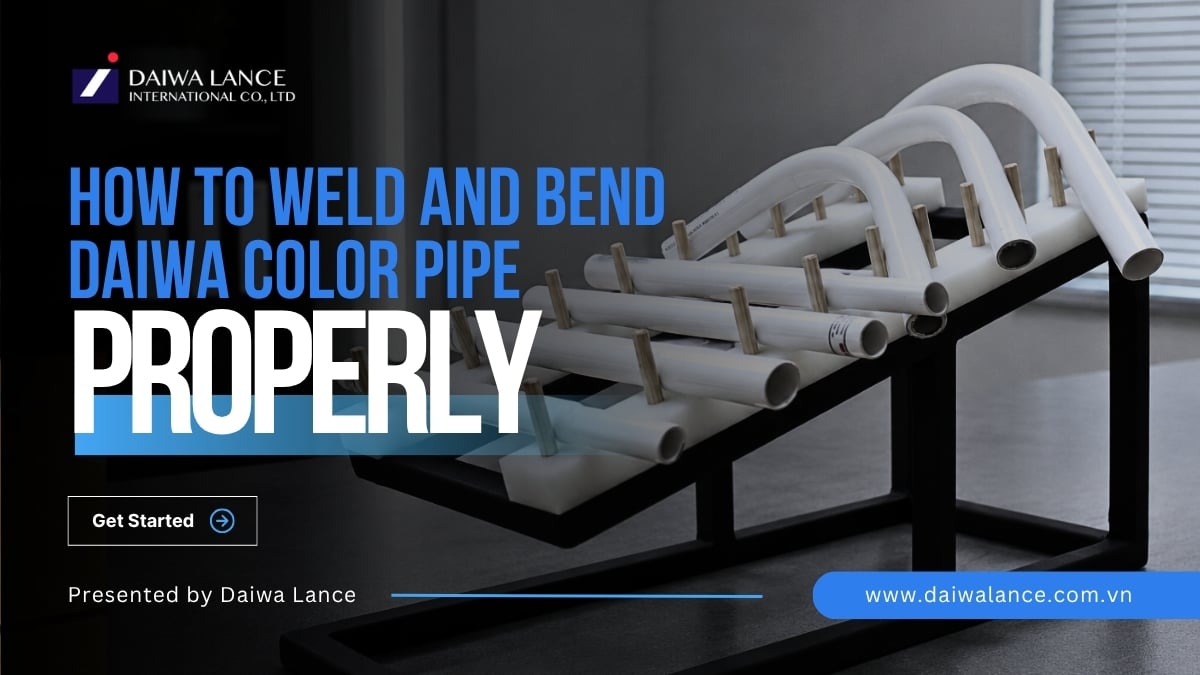
The Challenge of Fabricating Coated Structural Tubing
The core fabrication problem with coated tube is simple: heat and rough mechanical force destroy protective layers. Conventional post-production painted or plastic-coated steel tubing often behaves unpredictably during structural shaping - when subjected to thermal cutting or high-pressure deformation, the surface layers peel, split, or delaminate around the alteration zones.
Once that shield is compromised, atmospheric moisture, industrial gases, and chloride ions penetrate to the bare carbon steel base. This localized exposure initiates crevice corrosion beneath the coating and causes rapid structural decline. Avoiding this outcome requires two things: a substrate-and-coating system designed to tolerate fabrication, and a workforce trained in the correct procedures for it.
Understanding the Material: Coating Structure and Flexibility
Daiwa Color Pipe is built as a layered system: a steel tube core, a galvanized zinc layer on both the interior and exterior surfaces, and a polyester resin topcoat bonded over the zinc. The zinc acts as the sacrificial defense against corrosion; the resin seals the zinc away from moisture and oxygen.
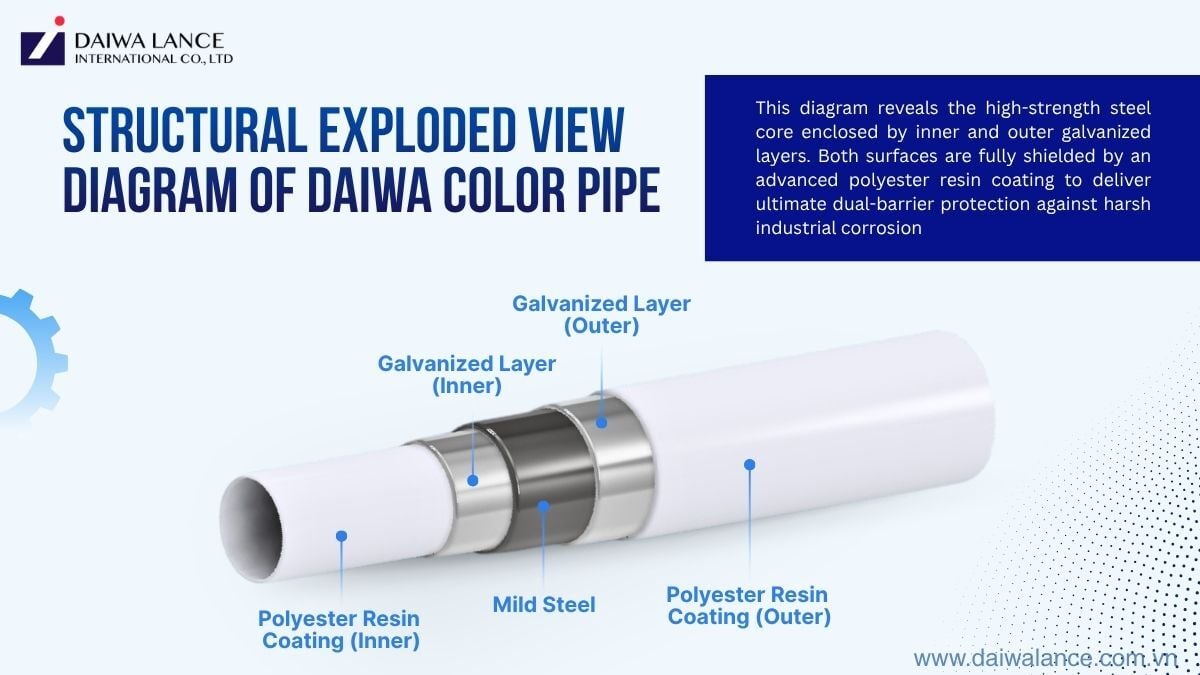
The property that matters most for fabrication is the flexibility of the polyester resin layer. It can follow the steel through considerable elongation and compression without micro-fracturing or peeling, which is what allows the tube to be cut, bent, and joined under controlled conditions while keeping a continuous barrier against corrosive elements.
The practical implication: fabrication damage to Daiwa Color Pipe is almost always a process problem - too much heat, too much localized force - rather than a material limitation. The procedures below are designed to stay inside the coating’s tolerance.
Step-by-Step - How to Cut Daiwa Color Pipe Correctly Before Processing
Every successful fabrication project begins with a clean, cold cut. Imprecise cutting generates friction heat and heavy burrs that distort the polymer topcoat well beyond the intended cut line.
Step 1 – Tool Selection
Avoid high-speed abrasive grinding discs; they generate intense heat that melts the adjacent polyester resin. Use a dedicated band saw with a fine-toothed bi-metal blade, or a low-speed cold circular saw with a high-speed steel (HSS) blade.
Step 2 – Securing the Workpiece
Clamp the tube firmly in a non-marring vice. Use polyurethane jaw inserts or wrap the clamping area in a protective rubber sheet so the jaw teeth do not scar the exterior coating.
Step 3 – Executing the Cut
Run the machine at low RPM with a steady, continuous feed. Apply a water-soluble coolant (flood or mist) to absorb friction heat at the cutting interface. Keeping the cut cool prevents the zinc layer from melting locally and protects the resin edge from thermal damage.
Step 4 – Deburring and Inspection
After the cut, remove internal and external burrs with a manual deburring tool or a fine-grit file. Direct the filing motion outward, away from the exterior topcoat, so nothing catches or lifts the polymer boundary. Inspect the cut edge before the piece moves to welding or bending.
How to Weld Daiwa Color Pipe Safely
Safe welding of coated pipe rests on two principles: never weld through the coating, and manage heat input tightly. Welding arcs operate far above the melting point of steel, so both the zinc layer and the resin topcoat must be dealt with deliberately.
Coating Removal Before Welding
Never strike an arc directly through the polyester resin topcoat. Doing so contaminates the weld pool with carbon soot, causes porosity, and generates thick polymer smoke.
Before welding, strip the resin layer back approximately 15–20 mm from the intended joint edge using a medium-grit flap disc or a chemical stripping compound. Work carefully so the underlying zinc layer stays as clean and intact as possible outside the immediate weld zone.
Executing the Weld Connection
Use Gas Tungsten Arc Welding (GTAW/TIG) or low-voltage Gas Metal Arc Welding (GMAW/MIG) with a high-purity argon shielding gas. Keep the electrical heat input as low as practicable to limit the width of the heat-affected zone (HAZ).
Maintain a consistent travel speed and complete the joint efficiently. This approach produces sound fusion and good tensile strength in the joint without thermally degrading the adjacent, non-stripped sections of the resin coat.
Welding Safety and Ventilation
Galvanized substrates and polymer topcoats release zinc oxide particulates and organic gases under welding heat, so ventilation controls are mandatory. Position source-capture fume extraction arms directly over the arc zone to draw contaminants away before they reach the welder’s breathing space.
Equip every welder with appropriate respiratory protection - a powered air-purifying respirator (PAPR) with particulate and organic vapor cartridges where required - alongside standard welding jackets and auto-darkening helmets. Keep the workspace clear of grinding dust, grease, and cutting fluids to prevent secondary flare-ups.
Bending Daiwa Color Pipe Without Cracking
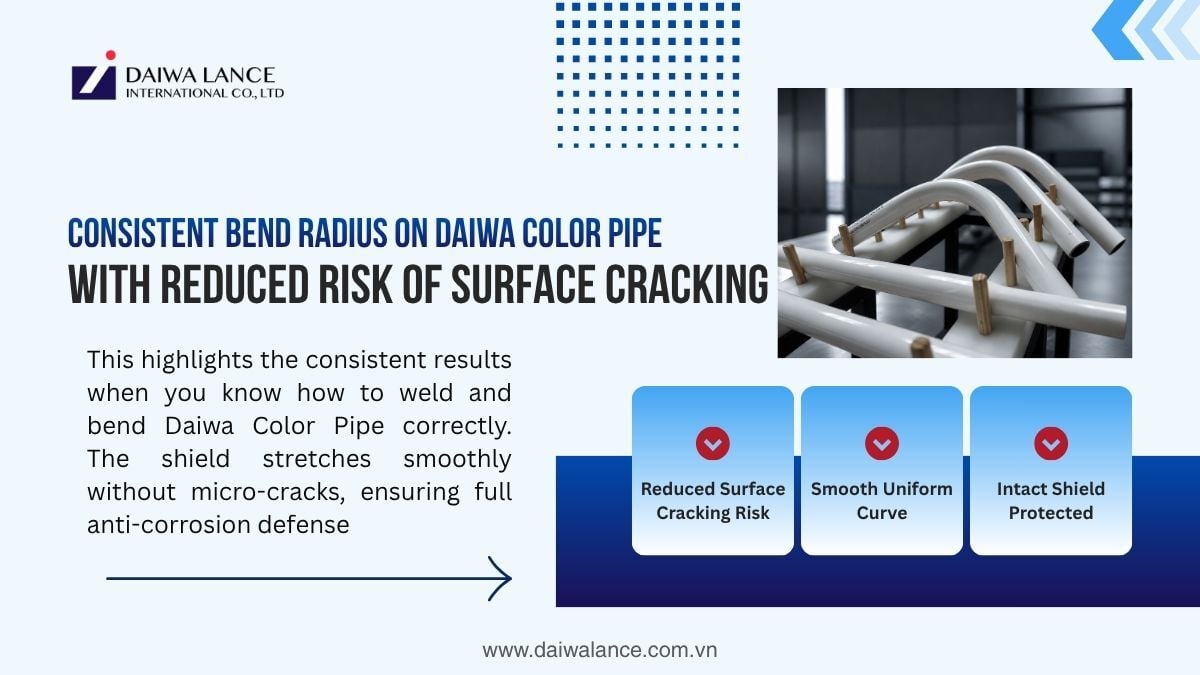
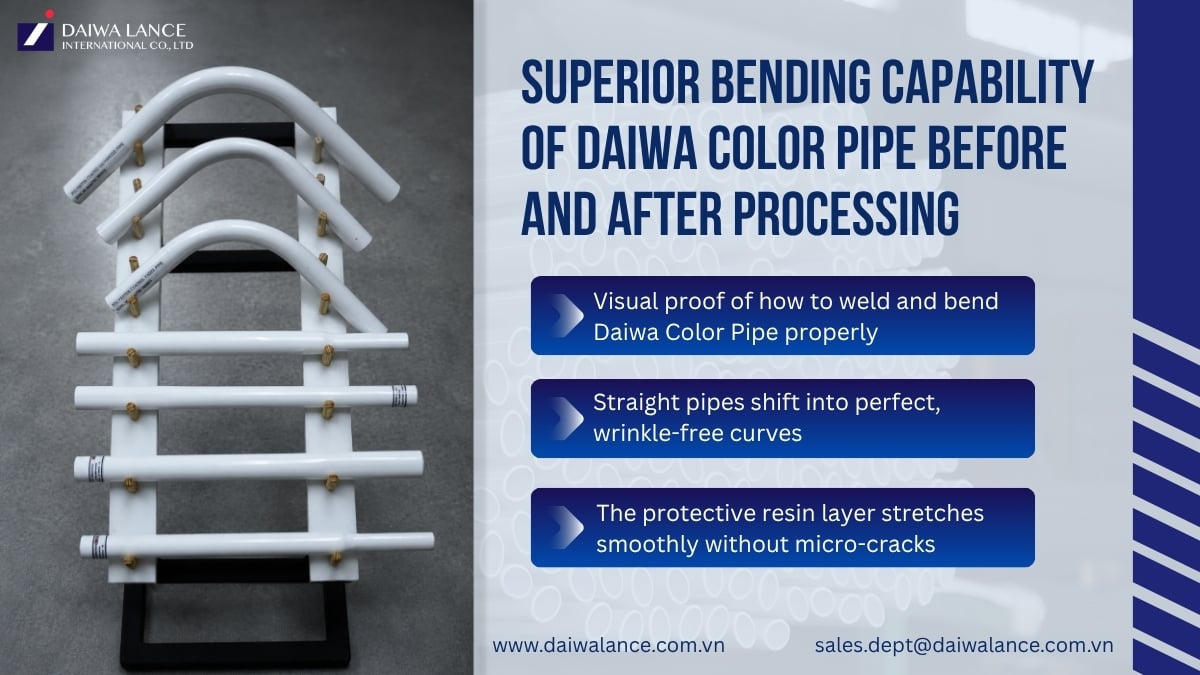
Cold-forming subjects the tube to simultaneous outer-radius tension and inner-radius compression, so the bending method determines whether the coating survives. Avoid crude, tight-radius manual jigs and serrated pipe benders; they concentrate force at single points and pinch or wrinkle coated tube.
Use a rotary draw bending machine with a smooth, precision-machined forming die set matched to the exact outer diameter of the tube. For thin-walled profiles, an internal mandrel is recommended to keep the cross-section round and prevent the inner radius from wrinkling.
Because the steel core is ductile and the resin layer flexible, the tube bends smoothly up to its engineered radius limits, with the polymer stretching uniformly alongside the steel. Stay within the recommended minimum bend radius for each diameter - confirm limits with the technical team when your design requires tight curves.
Post-Fabrication Care: Restoring the Protective Shield
After cutting, welding, and bending are complete, every stripped or heat-affected zone must be sealed before the assembly is deployed into humid or corrosive environments. These zones are temporary vulnerabilities, and left bare they become the exact crevice-corrosion entry points this product is designed to prevent.
First, allow the weldment to cool to ambient temperature. Remove all welding slag, soot, and surface oxides from the joint area with a clean stainless-steel wire brush, then wipe the surface with a fast-evaporating solvent degreaser so no moisture, oils, or residues remain.
Next, apply a zinc-rich cold galvanizing compound directly to the bare weld bead and adjacent exposed steel. This restores the sacrificial protection over the exposed joint.
Once the base coat has cured, apply a color-matched industrial-grade polyurethane or acrylic topcoat over the repair zone. This dual-layer touch-up seals the joint so the whole assembly performs as a single, uninterrupted barrier against external elements.
Common Fabrication Mistakes to Avoid
Most coating failures traced back to the workshop come from a short list of avoidable errors. Review this checklist before releasing work instructions to the floor:
- Cutting with abrasive grinding discs – friction heat melts the resin edge; always cut cold with fine-toothed blades and coolant.
- Welding through the coating – contaminates the weld pool and burns the polymer; strip 15–20 mm around the joint first.
- Excessive heat input – a wide heat-affected zone degrades coating beyond the stripped area; use TIG or low-voltage MIG and keep travel speed consistent.
- Bending with serrated or tight-radius jigs – point loading pinches the tube and cracks the coating; use rotary draw bending with matched dies.
- Skipping post-weld repair – bare weld zones corrode first; restore zinc-rich primer and topcoat on every joint before deployment.
- Storing fabricated assemblies on wet ground – trapped moisture attacks repaired zones before they cure; store dry and off the ground.
Production Standards Behind Fabrication-Ready Quality
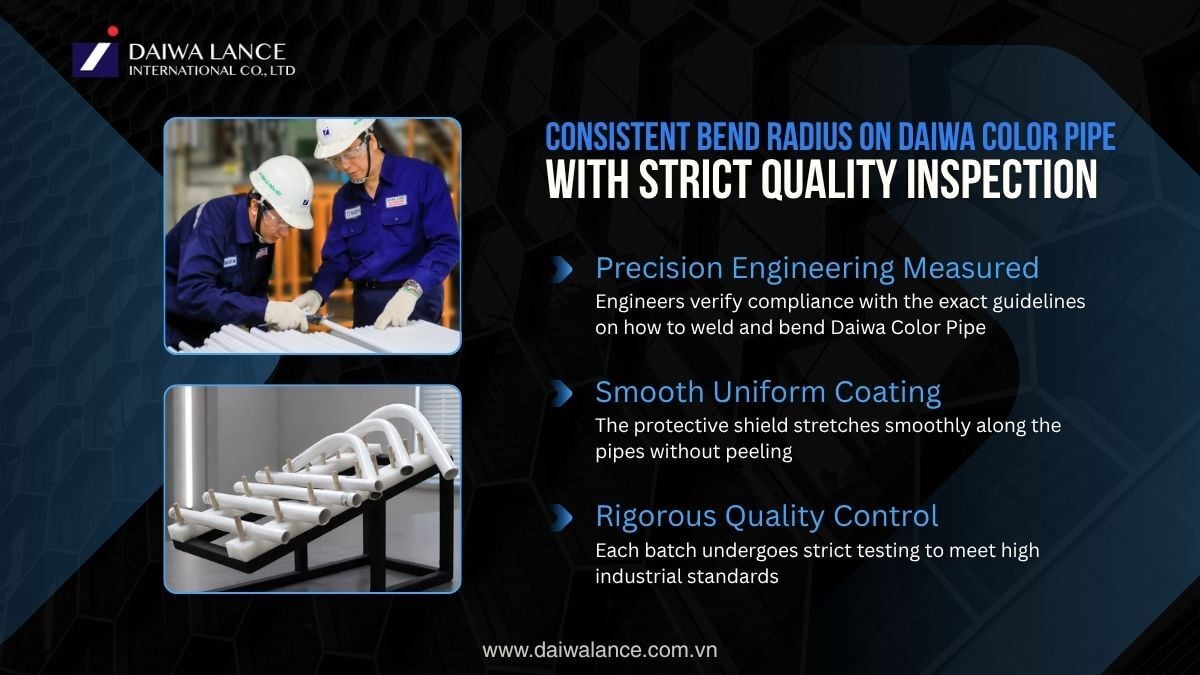
Reliable fabrication results start with consistent manufacturing, because uneven walls, weak seams, or oily surfaces turn into defects the moment heat or bending force is applied. Daiwa Color Pipe is produced under quality controls that directly support safe fabrication and safe end use:
- Consistent seam welds – uniform factory seam welding gives joints and bends predictable behavior and prevents splitting under load.
- Oil-free, clean surfaces – surfaces free of oils and hydrocarbons weld cleanly, hold coating repairs properly, and are safe to handle.
- Uniform wall thickness and straightness – tubes bend predictably and structures stay rigid without buckling or snapping under working loads.
- Strict quality control under ISO 9001 – each production batch is inspected under a certified quality management system.
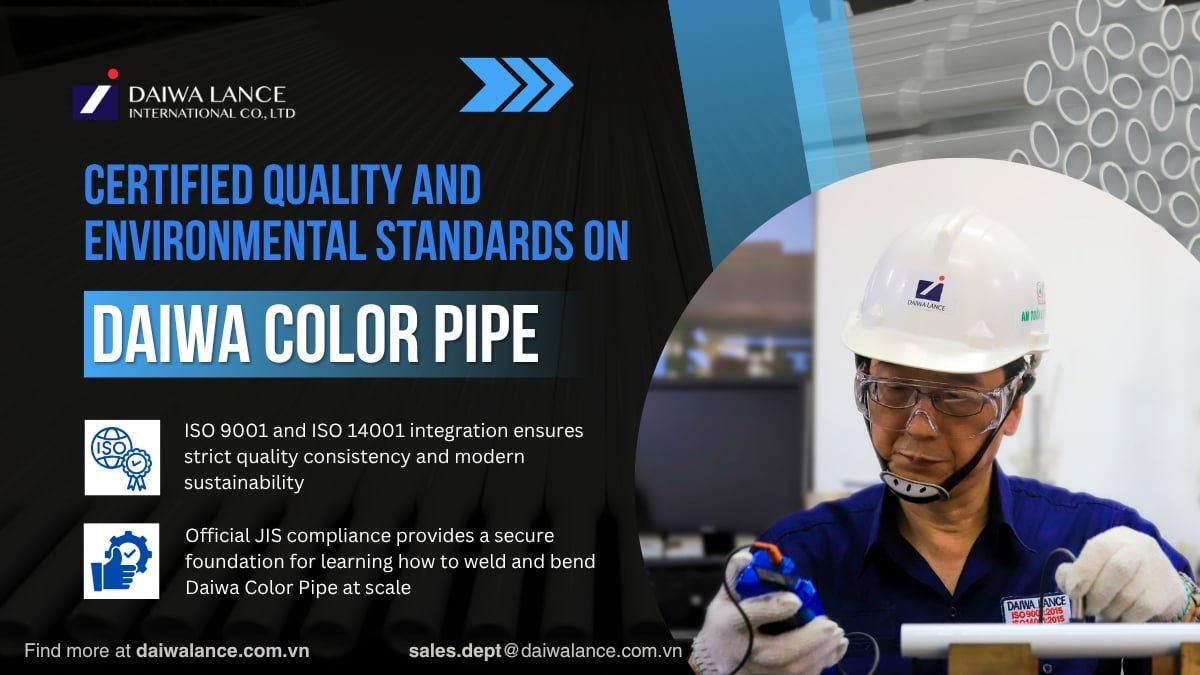
- Certified quality and environmental management – ISO 9001, ISO 14001, and JIS certifications validate mechanical strength and zinc coating weight against Japan’s industrial criteria.
Produced at the Daiwa Lance International factory in the Tan Thuan Export Processing Zone, Ho Chi Minh City, Vietnam, Daiwa Color Pipe combines advanced Japanese manufacturing technology with high-quality steel imported from Japan. With full export documentation support, Daiwa Lance supplies customers in more than 52 countries, while free samples are available for fabrication trials before volume orders (MOQ: 50 pipes).
Conclusion - Fabrication Without the Corrosion Trade-Off
Learning how to weld and bend Daiwa Color Pipe correctly lets industrial and agricultural enterprises build durable, moisture-resistant frameworks without giving up shop-floor flexibility. The combination of a ductile steel core, galvanized protection, and a flexible polyester resin topcoat removes the historical trade-off between easy fabrication and long-term corrosion defense - provided the cutting, welding, bending, and repair procedures in this guide are followed.
For technical guidance on bend radii, welding parameters, or dimensional availability, the Daiwa Lance engineering team supports procurement and fabrication teams directly.
Request a Quote: https://www.daiwalance.com.vn/contact
Download Catalogue: https://www.daiwalance.com.vn/catalogue
Contact Us: https://www.daiwalance.com.vn/contact
Free Samples: https://www.daiwalance.com.vn/free-samples
FAQ – How to Weld and Bend Daiwa Color Pipe Without Damage
Does welding color pipe release harmful fumes?
Yes. Under arc heat, the polyester resin topcoat burns and releases organic gases, and the zinc layer generates zinc oxide fumes. Always strip the coating back 15–20 mm from the weld zone before starting, run source-capture fume extraction over the arc, and use appropriate respiratory protection such as a PAPR with particulate and organic vapor cartridges.
What type of welding process is recommended for Daiwa Color Pipe?
TIG (GTAW) or low-voltage MIG (GMAW) with high-purity argon shielding gas. These processes let the operator control heat input precisely, keeping the heat-affected zone narrow and producing clean, high-integrity joints without overheating the adjacent coating.
Can I use standard hydraulic benders for bending color pipe without cracking?
Not recommended. Hydraulic ram benders apply localized pressure at single points and can pinch or wrinkle coated tube. For smooth curves without cracking, use a rotary draw bending machine with smooth, non-serrated forming dies that support the full outer diameter, plus an internal mandrel for thin-walled profiles.
How do I repair the coating if it gets scratched during fabrication?
Clean the area with an industrial solvent to remove contamination, apply a zinc-rich cold galvanizing primer to restore the sacrificial protection, then seal the zone with a color-matched industrial-grade topcoat. Repair scratches before the assembly enters humid or corrosive service.
Are custom diameters and wall thicknesses available for heavy industry?
Custom dimensions can be reviewed against client blueprints for volume orders. Daiwa Color Pipe is manufactured under ISO 9001 and JIS-certified production, with a range of calibrated outer diameters and wall thicknesses - confirm the current lineup and customization options with the technical team at the RFQ stage.
Related Blogs & Pages
-
Daiwa Color Pipe product page: https://www.daiwalance.com.vn/products/daiwa-color-pipe
-
Polyester resin coated color pipe vs galvanized pipe: https://www.daiwalance.com.vn/blog/polyester-resin-coated-color-pipe-vs-galvanized-pipe
-
Catalogue page: https://www.daiwalance.com.vn/catalogue
-
Free samples: https://www.daiwalance.com.vn/free-samples
-
Contact page: https://www.daiwalance.com.vn/contact
About Daiwa Lance
Established since 1997, Daiwa Lance has positioned ourselves as a pioneer in thermic cutting and oxygen lancing technology. Based in Ho Chi Minh City, Vietnam, we have been providing quality customer service and products with advanced Japanese technology.
We maintain the highest quality standards with ISO 9001:2015, ISO 14001:2015, and JIS G standards certifications. We have also expanded our reach globally, exporting to over 55 countries worldwide.
Visit us through our contact channels today: Email, WhatsApp, Contact Us form, or connect with us on Youtube, LinkedIn and Facebook.