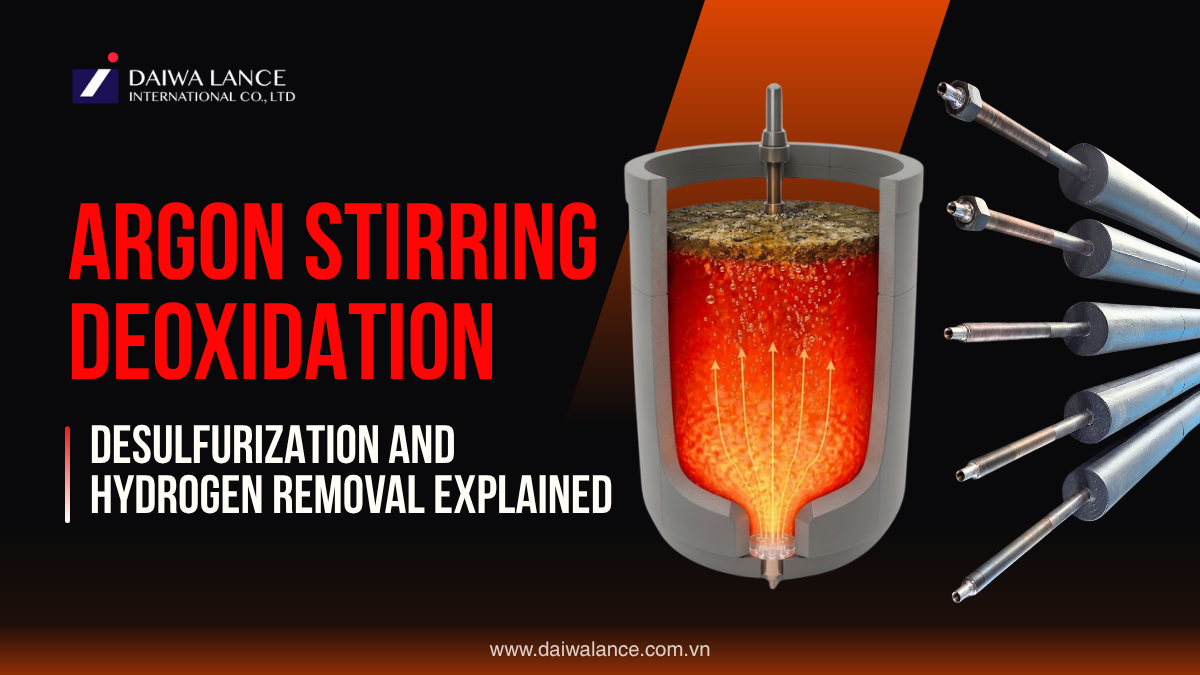
Argon stirring deoxidation is the use of inert gas stirring in the ladle to support the removal of oxygen from liquid steel, primarily by circulating the melt so that deoxidation products can float out to the slag. The same stirring action supports desulfurization and assists removal of dissolved hydrogen and nitrogen.
For ladle furnace operators, metallurgists and engineers, understanding these mechanisms helps connect stirring practice to steel quality. This article explains that relationship and the role of a top-entry lance in maintaining stirring capability during secondary refining.
The Challenge - Dissolved Gases and Impurities Cap Steel Quality
Liquid steel leaving the furnace carries several things that the finished product cannot tolerate: dissolved oxygen, sulphur, dissolved hydrogen and nitrogen, and non-metallic inclusions.
Chemistry alone does not remove them. Adding a deoxidiser produces oxide particles that must then leave the steel. Adding a desulphurising slag creates a reaction site that the sulphur must reach. Hydrogen and nitrogen already in solution need somewhere to go.
Every one of these is a transport problem before it is a chemistry problem. Reagents do the reacting; stirring does the transporting.
What Does Argon Stirring Actually Do?
Argon is injected into the melt and rises. That ascent produces three simultaneous effects, and every metallurgical outcome discussed below depends on one or more of them.
Dispersing Argon through The Melt
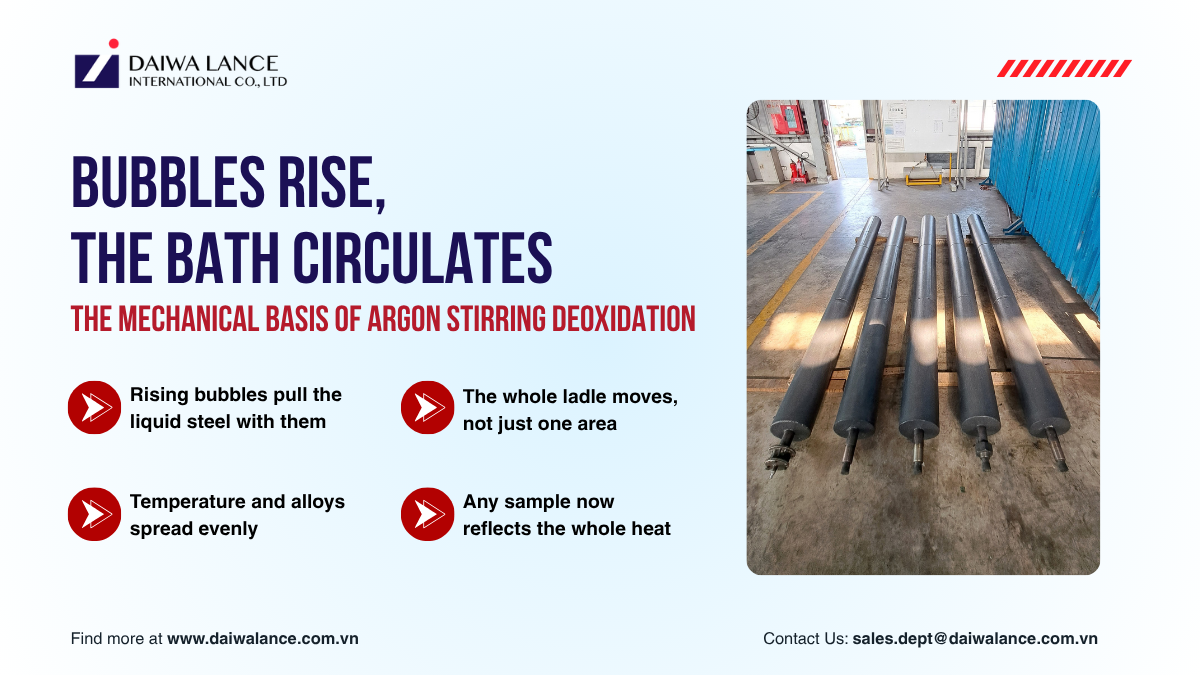
Rising bubbles drag surrounding liquid with them, setting up circulation through the ladle volume. This is the mechanical basis of everything else. Without circulation, reactions occur only where reagents happen to be, and only until local conditions are exhausted.
Homogenising Temperature and Composition
Circulation evens out temperature between the top and bottom of the bath and distributes alloy additions through the full volume. A homogeneous bath is a prerequisite for consistent chemistry at the caster and for meaningful sampling - a sample taken from a stratified ladle describes one region, not the heat.
How Does Argon Stirring Deoxidation Work?
Deoxidation is usually performed by adding an element with a strong affinity for oxygen. The reaction produces solid or liquid oxide particles suspended in the steel.
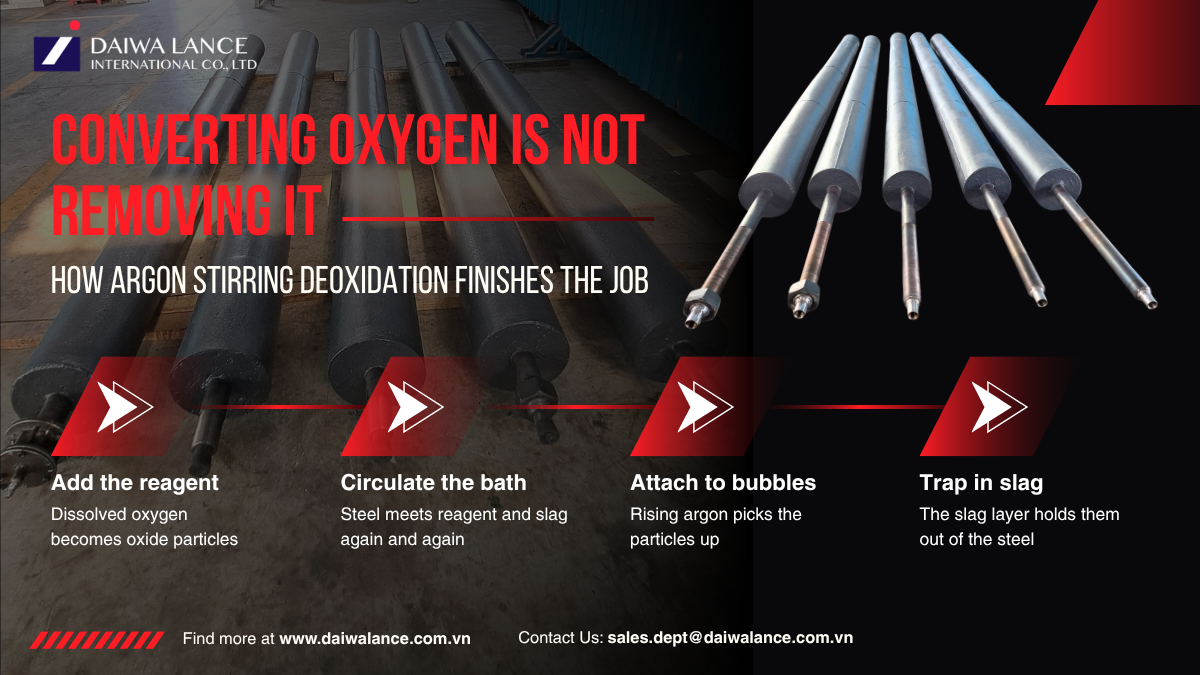
At that point the oxygen has been converted, not removed. If those oxide particles remain in the melt they become non-metallic inclusions in the finished product - which is exactly the defect the deoxidation was intended to prevent.
Stirring completes the job in two ways. Circulation brings steel into repeated contact with the reagent and with the slag, so the reaction proceeds through the volume rather than locally. Rising bubbles then provide surfaces that oxide particles attach to and are carried upward on, delivering them to the slag layer where they can be held.
How Does Stirring Support Desulfurization?
Desulfurization takes place at the interface between the steel and the slag. Sulphur transfers from the metal into a slag conditioned to receive it.
The reaction is therefore limited by how much steel reaches that interface and how often. A quiescent ladle presents the same steel to the same slag; the reaction slows as local equilibrium is approached. Stirring continually renews the metal at the interface, which is why secondary refining argon practice and desulfurization results are closely linked in ladle metallurgy.
Slag chemistry sets what is possible. Stirring determines how much of that possibility is realised in the time available.
How Does Argon Remove Dissolved Hydrogen and Nitrogen?
This mechanism is different from the two above, because it does not depend on the slag at all.
An argon bubble entering the melt contains essentially no hydrogen and no nitrogen. The steel around it does. That difference in partial pressure drives dissolved gas to diffuse across the gas–metal interface into the bubble, which then carries it out of the bath.
Two factors govern how much leaves: the total bubble surface area presented to the steel, and the contact time before the bubble reaches the surface. Both are influenced by how the gas is introduced, which connects hydrogen removal molten steel outcomes and nitrogen removal steel outcomes to outlet selection on the lance itself.
|
Mechanism |
What it depends on |
What stirring contributes |
|
Deoxidation |
Reagent contact and inclusion flotation |
Circulation through the volume; bubble surfaces for oxide particles to attach to |
|
Desulfurization |
Steel - slag interface area and renewal |
Continual renewal of metal at the interface |
|
Hydrogen and nitrogen removal |
Bubble surface area and contact time |
Gas - metal interface carried out of the bath by rising argon |
|
Temperature and composition uniformity |
Bulk circulation |
Even distribution through the ladle volume |
Emergency Stirring in Secondary Refining
Most ladles stir through a porous plug in the floor. When that plug blocks, wears or fails, stirring capability stops and the heat cannot wait for a repair.
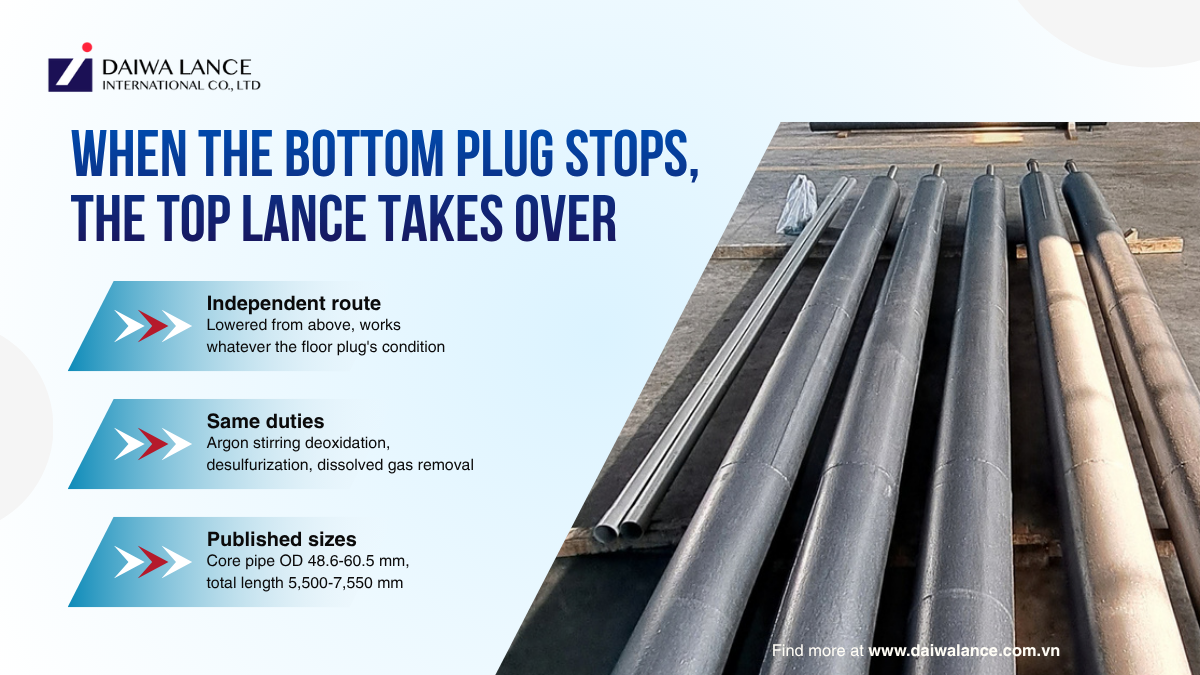
A top lance provides an independent route. It is lowered into the ladle from above and injects argon at the required depth regardless of the condition of the bottom plug. This is why emergency stirring in secondary refining is listed among the applications of the Daiwa Argon Stirring Lance, alongside dispersing argon to homogenise temperature and composition, removing dissolved gases, and supporting deoxidation and desulfurization.
The lance is built in three layers: a calorized steel protective shell, a rich alumina refractory coating specified at Al₂O₃ = 80% and requiring proper drying, and a calorized core steel pipe. Published dimensions are a core pipe outside diameter of 48.6-60.5 mm, wall thickness of 3.6-14.2 mm, core pipe length of 4,000-6,000 mm and total lance length of 5,500-7,550 mm.
Safety in Use for Argon Stirring Lance
Ladle furnace degassing and stirring involve molten steel, compressed gas and overhead handling. Safe operation requires a sound lance, suitable handling equipment and adherence to approved site procedures.
-
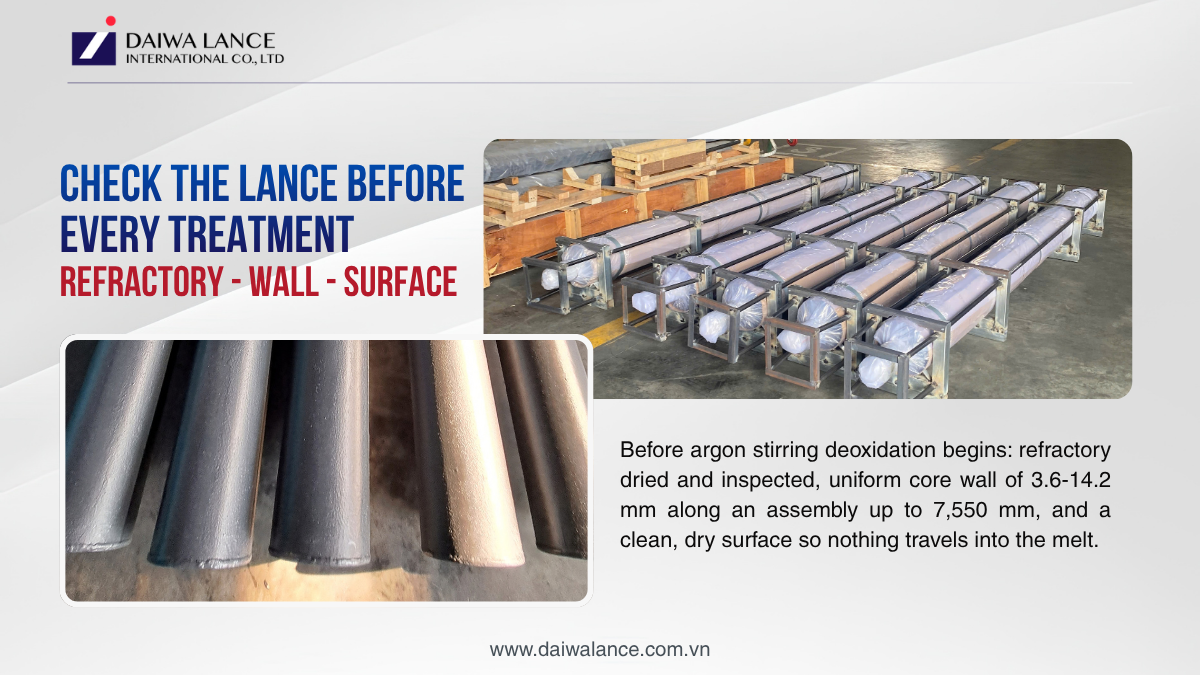
Inspect the refractory before every use: Ensure the alumina refractory coating is properly dried in accordance with the manufacturer’s instructions. Do not immerse a lance with cracking or spalling.
-
Confirm the core pipe specification: Published core pipe wall thicknesses range from 3.6–14.2 mm, with total lance lengths up to 7,550 mm. Wall thickness uniformity supports structural integrity, but does not replace verification that the complete assembly is suitable for the intended operating conditions.
-
Keep the lance clean and dry: Maintain oil- and grease-free surfaces during delivery, storage and handling to avoid introducing contaminants into the melt.
-
Verify manufacturing quality: Daiwa Lance products are manufactured under ISO 9001 quality management and ISO 14001 environmental management systems, with inspection to applicable JIS requirements. These controls complement, rather than replace, pre-use checks.
Before lowering the lance, confirm the immersion depth against the measured ladle depth and available freeboard. Ensure the handling equipment is suitable for the assembly’s full length and weight. Use the required personal protective equipment and ventilation, and follow site procedures for molten-metal handling and compressed-gas operation.
Common Mistakes to Avoid
- Treating deoxidation as complete once the reagent has been added, without allowing time for inclusions to float out.
- Sampling a ladle before it has been homogenised and treating the result as representative of the heat.
- Assuming slag chemistry alone will deliver desulfurization without adequate interface renewal.
- Shortening the treatment window under schedule pressure without recording the effect on quality outcomes.
- Operating without an independent stirring capability when the bottom plug is the only route.
- Returning a lance to service without inspecting the refractory coating.
Conclusion
Argon stirring connects the main objectives of secondary refining: a uniform bath, effective impurity removal and consistent steel chemistry. By circulating the melt, it distributes heat and alloy additions, supports the separation of deoxidation products and renews contact between steel and slag for desulfurization. At the same time, rising argon bubbles provide an interface for dissolved gases to leave the steel. These mechanisms differ, but each depends on suitable stirring conditions and sufficient treatment time.
Maintaining that stirring capability is therefore part of controlling steel quality. If the bottom porous plug fails, a top-entry lance provides an independent route for argon injection, helping operators continue treatment under approved site procedures. Its effectiveness depends not only on selecting the appropriate length, core pipe and nozzle configuration, but also on proper refractory drying, pre-use inspection and safe handling.
The Daiwa Argon Stirring Lance brings these requirements together in a heat-resistant, top-entry solution for secondary refining and emergency stirring. Contact Daiwa Lance to discuss a configuration suited to your ladle dimensions and operating conditions, or request a quotation to support your plant’s refining and contingency plans.
FAQs
Does argon chemically remove oxygen from steel?
No. Argon is inert and does not react with the steel. Deoxidation is performed by a reagent; argon stirring supports it physically by circulating the melt so the reaction proceeds through the volume, and by providing rising bubble surfaces that carry the resulting oxide particles up to the slag layer where they can be held.
Why does stirring matter for desulfurization?
Because desulfurization occurs at the steel - slag interface. A still ladle presents the same steel to the same slag and the reaction slows as local equilibrium is approached. Stirring continually renews the metal at that interface, allowing the reaction to continue through the treatment window rather than stalling.
How are hydrogen and nitrogen removed?
An argon bubble entering the melt contains essentially no hydrogen or nitrogen while the surrounding steel does. That difference drives dissolved gas to diffuse into the bubble, which carries it out of the bath. How much leaves depends on total bubble surface area and on contact time before the bubble reaches the surface.
What happens if the bottom porous plug fails mid-treatment?
Stirring capability stops, and the plant must either accept a compromised heat or hold the ladle. A top lance provides an independent route, injecting argon from above regardless of the plug's condition - which is why emergency stirring in secondary refining is listed among the applications of the Daiwa Argon Stirring Lance.
What is the Daiwa Argon Stirring Lance made from?
Three layers: a calorized steel protective shell, a rich alumina refractory coating specified at Al₂O₃ = 80% requiring proper drying, and a calorized core steel pipe. Core pipe outside diameter is 48.6-60.5 mm, wall thickness 3.6-14.2 mm, core pipe length 4,000-6,000 mm and total lance length 5,500-7,550 mm.
Related Blogs & Pages
- Website: https://www.daiwalance.com.vn/
- Catalogue page: https://www.daiwalance.com.vn/catalogue
- Contact page: https://www.daiwalance.com.vn/contact
- What is The Structure of Argon Stirring Lance ?: https://www.daiwalance.com.vn/blog/what-is-the-key-properties-of-argon-stirring-lance
- Why is The Argon Stirring Lance Used As An Emergency Lance in Steelmaking?: https://www.daiwalance.com.vn/blog/why-is-the-argon-stirring-lance-used-as-an-emergency-lance-in-steelmaking
- Improving Steel Quality Through Daiwa Argon Stirring Lance: https://www.daiwalance.com.vn/blog/improving-steel-quality-through-daiwa-argon-stirring-lance
- Desulfurization In Ladle Refining Furnace: https://www.daiwalance.com.vn/blog/desulfurization-in-ladle-refining-furnace
About Daiwa Lance
Established since 1997, Daiwa Lance has positioned ourselves as a pioneer in thermic cutting and oxygen lancing technology. Based in Ho Chi Minh City, Vietnam, we have been providing quality customer service and products with advanced Japanese technology.
We maintain the highest quality standards with ISO 9001:2015, ISO 14001:2015, and JIS G standards certifications. We have also expanded our reach globally, exporting to over 55 countries worldwide.
Visit us through our contact channels today: Email, WhatsApp, Contact Us form, or connect with us on Youtube, LinkedIn and Facebook.