Argon Lance outlet types are the three exit configurations available on a Daiwa Argon Stirring Lance: the Straight-Through Exit at Ø19.0 mm, the Porous Plug Exit and the Tri-Port Exit. The outlet determines how argon is released into the melt, which in turn shapes bubble behaviour and the character of the stir.
For ladle furnace engineers and procurement teams, selecting a lance configuration means matching the outlet design to the process requirements. This article compares the three options and explains how ladle geometry, refining objectives and customization needs should guide the choice.
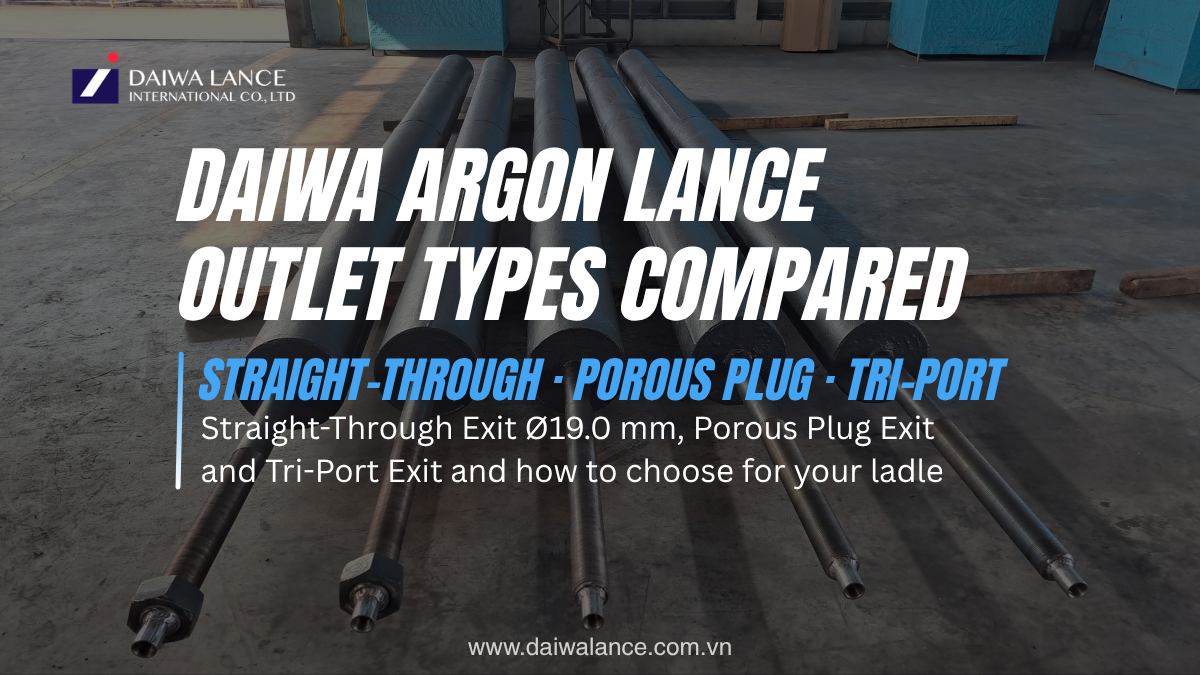
The Challenge - How Argon Leaves The Lance Shapes The Stir?
Two lances can deliver the same quantity of argon to the same depth and produce noticeably different results in the ladle. The difference lies at the exit.
Gas leaving through a single opening behaves differently from gas leaving through many small openings. Large bubbles rise quickly and impart momentum; smaller bubbles rise more slowly, present more total surface area for their volume, and spend longer in contact with the steel. Whether one behavior or the other suits a particular treatment depends on what that treatment is meant to achieve.
Selecting an outlet by default - because it is what was ordered last time - leaves that variable unmanaged.
The Three Daiwa Argon Lance Outlet Types
Straight-Through Exit (Ø19.0 mm)
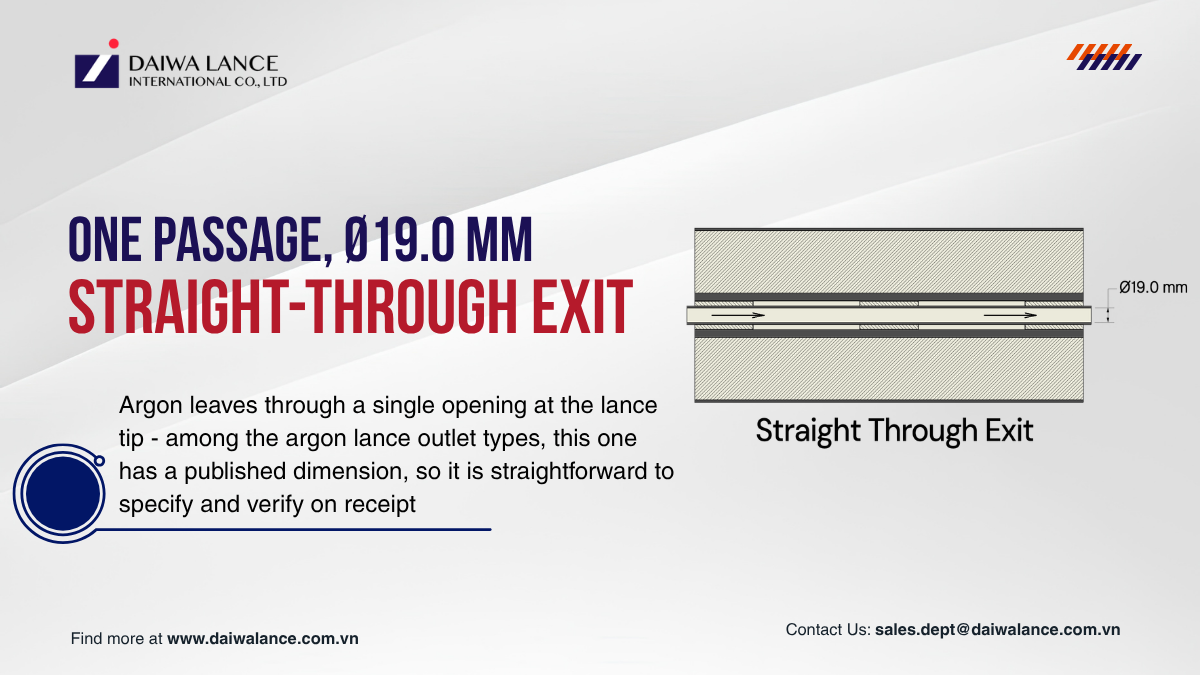
The Straight-Through Exit is a single defined passage of Ø19.0 mm. Argon exits through one opening at the lance tip.
This is the only outlet configuration for which a published dimension is available, which makes it the reference point when comparing options and the most straightforward to specify and to verify on receipt.
Porous Plug Exit
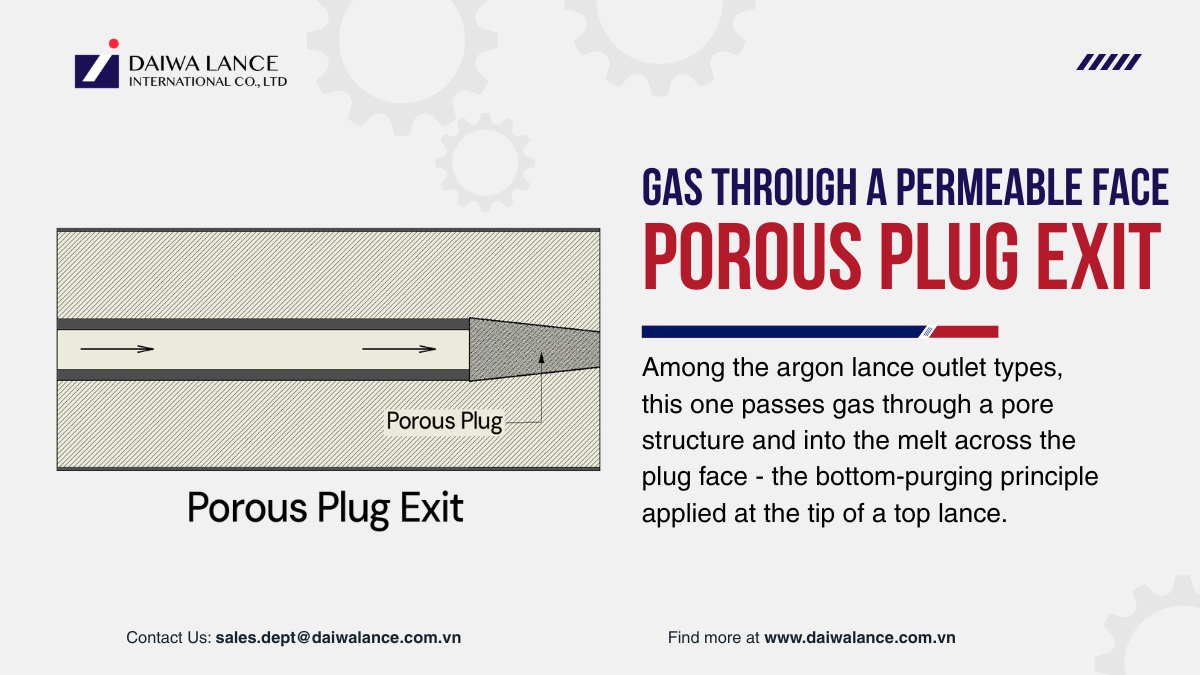
The Porous Plug Exit releases argon through a permeable element rather than a single opening. Instead of one exit path, the gas passes through the pore structure of the material and enters the melt distributed across the plug face.
The name reflects the same principle used in bottom-purging plugs, applied at the tip of a top lance rather than in the ladle floor.
Tri-Port Exit
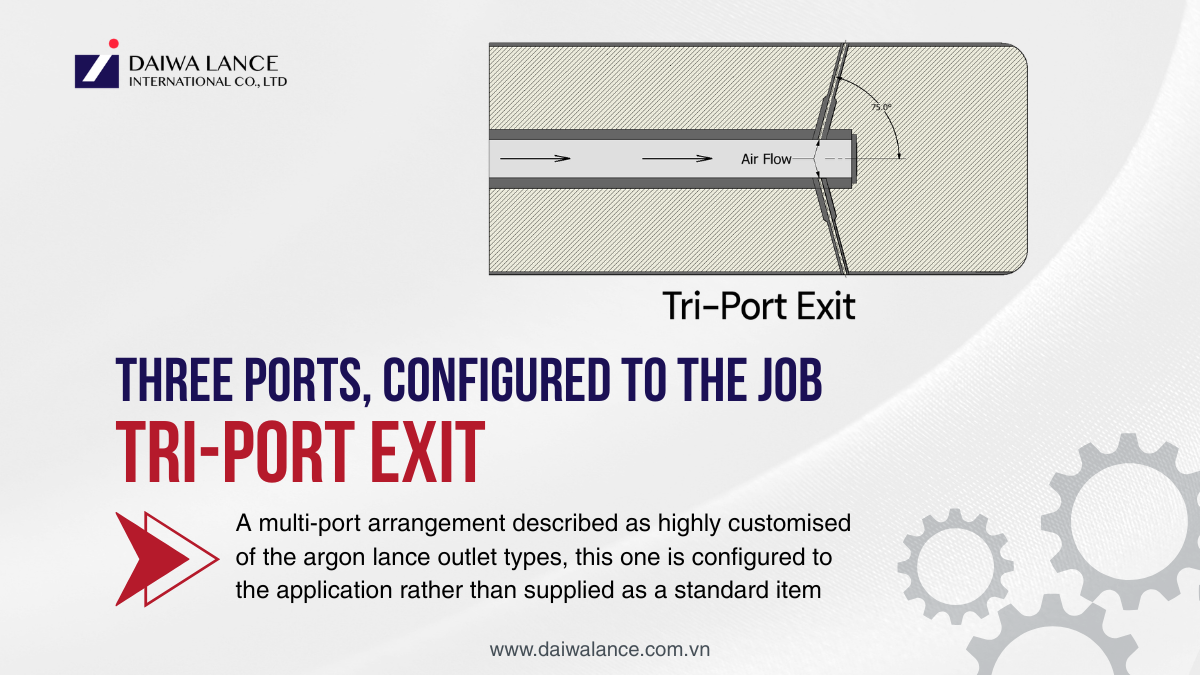
The Tri-Port Exit uses a multi-port arrangement and is described in the product documentation as highly customized. Rather than a standard item, it is configured to the application.
Outlet Type Comparison of Argon Stirring Lance
|
Characteristic |
Straight-Through Exit |
Porous Plug Exit |
Tri-Port Exit |
|
Exit configuration |
Single defined passage |
Permeable element |
Multi-port arrangement |
|
Published dimension |
Ø19.0 mm |
||
|
Gas entry into melt |
Concentrated at one point |
Distributed across the plug face |
Divided between ports |
|
Customization |
Standard published dimension |
Described as highly customized |
|
|
Specification and verification |
Simple - one stated diameter |
Requires manufacturer confirmation |
Configured per application |
How Do You Choose An Outlet Type?
Three factors carry most of the decision.
Ladle Size and Depth
Ladle depth determines how far a bubble travels before it reaches the surface, and therefore how long it remains in contact with the steel. A deep ladle gives a rising bubble a long path; a shallow one does not.
Depth also constrains the lance itself. The Daiwa Argon Stirring Lance is supplied with a core pipe length of 4,000-6,000 mm and a total lance length of 5,500-7,550 mm. Outlet selection and length selection are made together, since both are governed by the same ladle geometry.
Refining Objective
What the treatment is meant to achieve should influence how the gas is introduced. Homogenizing temperature and composition is a bulk circulation problem. Floating inclusions toward the slag and removing dissolved hydrogen and nitrogen depend on the surface area available at the gas–metal interface and on contact time.
These objectives are not in conflict, but they are not identical either, and argon bubble distribution is the variable that connects the outlet to the outcome.
Customization Options
Where a standard configuration does not suit the application, the Tri-Port Exit is documented as highly customized. A custom argon lance outlet is worth discussing at enquiry stage rather than after a standard item has underperformed - the specification conversation is considerably easier before an order than after one.
What to Confirm Before Ordering Argon Stirring Lance?
Whichever outlet is selected, the same information determines whether the lance will fit and function:
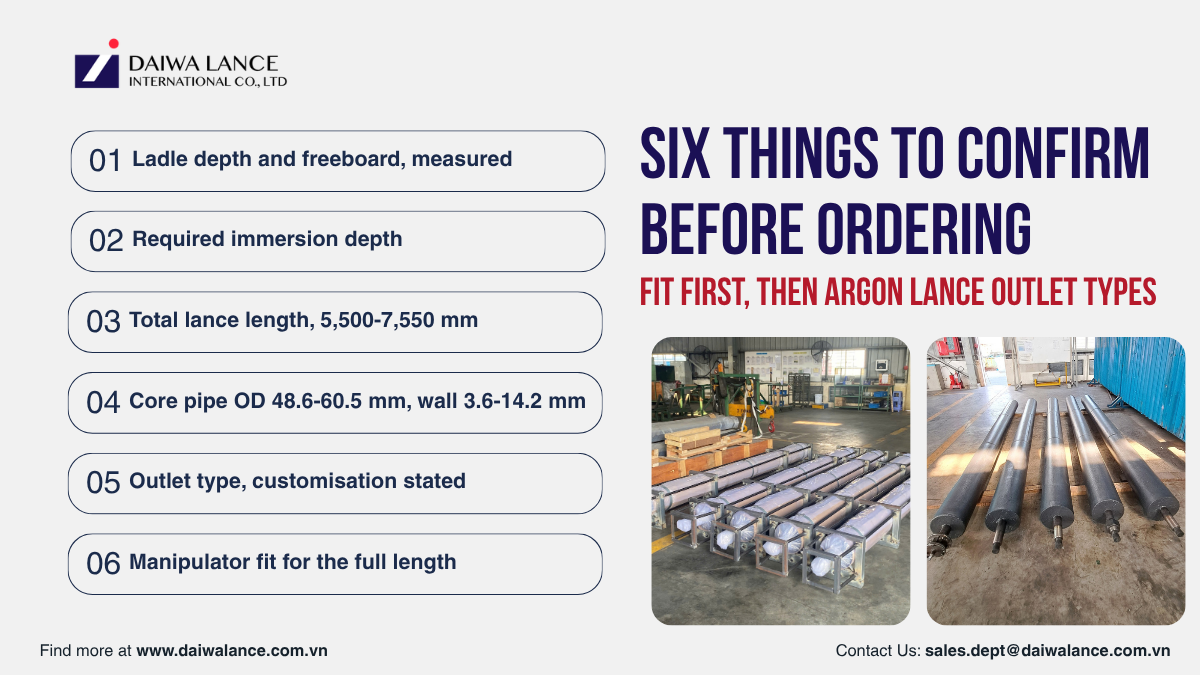
- Ladle depth and freeboard, measured rather than assumed.
- Required immersion depth for the treatment.
- Total lance length needed - from the 5,500-7,550 mm range, not core pipe length.
- Core pipe dimensions - outside diameter 48.6-60.5 mm and wall thickness 3.6-14.2 mm.
- Outlet type, with any customization stated explicitly.
- Handling and manipulator compatibility for the full assembled length.
Safety In Use of Daiwa Argon Stirring Lance
Outlet selection does not change the safety requirements that apply to every lance entering a ladle.
- Verified refractory condition. The rich alumina refractory coating, specified at Al₂O₃ = 80%, must be properly dried and inspected before each use. Cracking or spalling means the lance does not go into the ladle.
- Uniform wall thickness. With a core pipe wall of 3.6-14.2 mm carrying an assembly up to 7,550 mm long, even wall thickness is what allows the lance to resist bending and breaking while extended over a ladle.
- Clean, oil-free and grease-free surface. Lances must arrive clean and be stored clean and dry, so that contamination is not carried into the melt.
- Rigorous quality control. Daiwa Lance products are manufactured under ISO 9001 quality management and ISO 14001 environmental management, and inspected to JIS.
Confirm immersion depth against measured ladle depth before lowering. Handling equipment must be rated for the full assembled length. Personal protective equipment and adequate ventilation are required for heat and fumes.
Common Mistakes to Avoid
- Reordering the previous outlet type without reviewing whether the refining objective has changed.
- Estimating Porous Plug or Tri-Port dimensions from the Ø19.0 mm Straight-Through figure.
- Selecting an outlet before confirming ladle depth and required immersion depth.
- Raising customization requirements after an order rather than at enquiry.
- Working from core pipe length instead of total lance length when checking fit.
- Treating outlet selection as a procurement decision rather than a process one.
Conclusion
Argon lance outlet types are a process decision presented as a procurement one. The Straight-Through Exit at Ø19.0 mm is the published reference point; the Porous Plug Exit distributes gas through a permeable element; the Tri-Port Exit is a multi-port arrangement configured to the application. Confirm ladle depth and immersion depth first, state the refining objective, and raise customisation requirements at enquiry rather than after delivery.
The choice of argon lance tip design should be based on ladle depth, refining objectives, and gas dispersion requirements, rather than simply relying on previously used configurations. Daiwa offers Argon Stirring Lances featuring a straight Ø19.0 mm tip, a porous plug tip, and a three-port tip, all customizable to specific applications. Contact Daiwa Lance for advice on the configuration best suited to your steel ladle and plant processes, or to request a quote for your specific specifications.
FAQs
What outlet options are available on a Daiwa Argon Stirring Lance?
Three: the Straight-Through Exit at Ø19.0 mm, the Porous Plug Exit and the Tri-Port Exit. The Straight-Through Exit is a single defined passage, the Porous Plug Exit releases gas through a permeable element, and the Tri-Port Exit is a multi-port arrangement described as highly customised.
What is the diameter of the Straight-Through Exit?
Ø19.0 mm. This is the only outlet configuration with a published dimension. Figures for the Porous Plug Exit and Tri-Port Exit are not published and should be confirmed with the manufacturer rather than estimated from the Straight-Through figure.
Does outlet type affect how argon behaves in the melt?
It affects how the gas is introduced. A single passage concentrates entry at one point; a permeable element distributes it across the plug face; a multi-port arrangement divides it between ports. Bubble behaviour follows from that. Comparative performance data for the three configurations against specific refining objectives is not published.
Can an outlet be customised?
Yes. The Tri-Port Exit is documented as highly customised. Customisation requirements should be raised at enquiry stage together with ladle depth, required immersion depth and total lance length, since these are decided together rather than sequentially.
What else must be confirmed before ordering?
Measured ladle depth and freeboard, required immersion depth, total lance length from the 5,500-7,550 mm range, core pipe outside diameter of 48.6-60.5 mm, wall thickness of 3.6-14.2 mm, and compatibility of the handling equipment with the full assembled length.
Related Blogs & Pages
- Website: https://www.daiwalance.com.vn/
- Catalogue page: https://www.daiwalance.com.vn/catalogue
- Contact page: https://www.daiwalance.com.vn/contact
- What is The Structure of Argon Stirring Lance ?: https://www.daiwalance.com.vn/blog/what-is-the-key-properties-of-argon-stirring-lance
- Why is The Argon Stirring Lance Used As An Emergency Lance in Steelmaking?: https://www.daiwalance.com.vn/blog/why-is-the-argon-stirring-lance-used-as-an-emergency-lance-in-steelmaking
- Improving Steel Quality Through Daiwa Argon Stirring Lance: https://www.daiwalance.com.vn/blog/improving-steel-quality-through-daiwa-argon-stirring-lance
- Desulfurization In Ladle Refining Furnace: https://www.daiwalance.com.vn/blog/desulfurization-in-ladle-refining-furnace
About Daiwa Lance
Established since 1997, Daiwa Lance has positioned ourselves as a pioneer in thermic cutting and oxygen lancing technology. Based in Ho Chi Minh City, Vietnam, we have been providing quality customer service and products with advanced Japanese technology.
We maintain the highest quality standards with ISO 9001:2015, ISO 14001:2015, and JIS G standards certifications. We have also expanded our reach globally, exporting to over 55 countries worldwide.
Visit us through our contact channels today: Email, WhatsApp, Contact Us form, or connect with us on Youtube, LinkedIn and Facebook.